
At the base of the Chugach Mountains in south-central Alaska is the Anchorage Museum, a building with a cloud-reflecting façade of glass. Inside on its second floor, is the Arctic Studies Center. There along with murals, panels, soundscapes, touch screens and seven large video monitors is an impressive collection of more than 600 items that originated from Indigenous communities across the state.
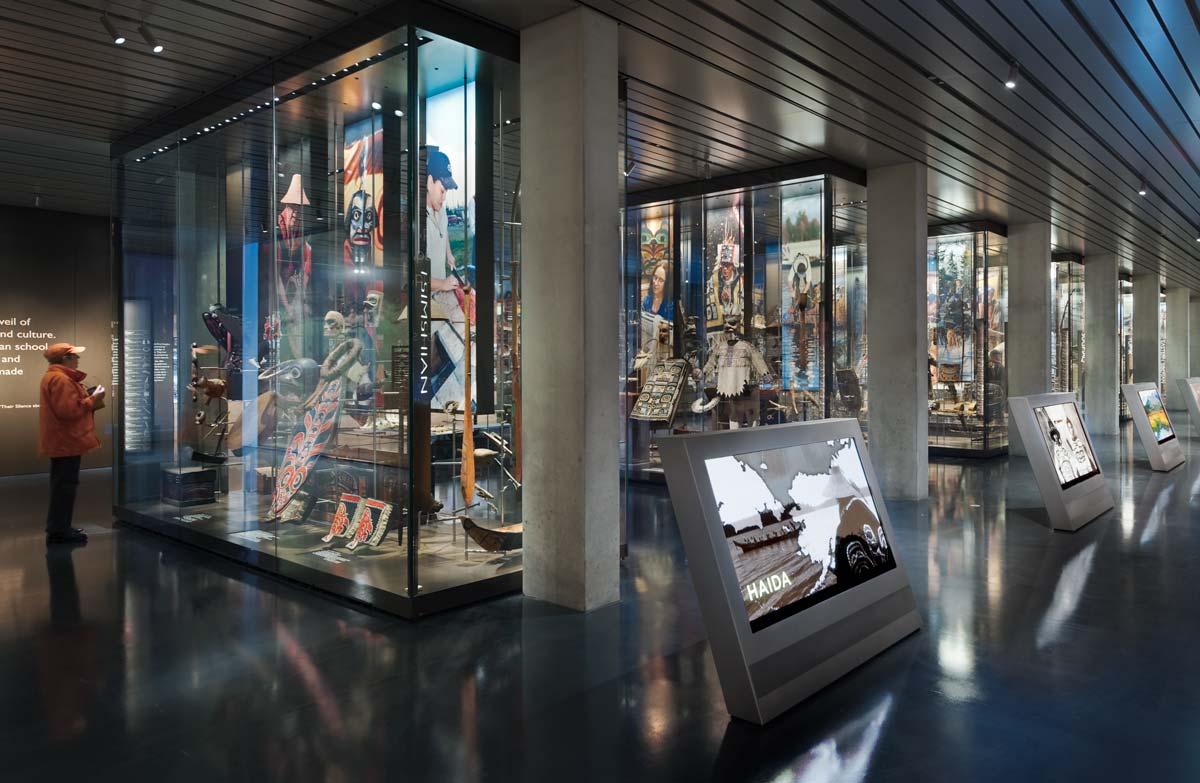
The “Living Our Cultures, Sharing Our Heritage” exhibition at the Smithsonian Arctic Studies Center features a wide range of items from Native communities across Alaska.
Photo by Chuck Choi, Courtesy of the Anchorage Museum
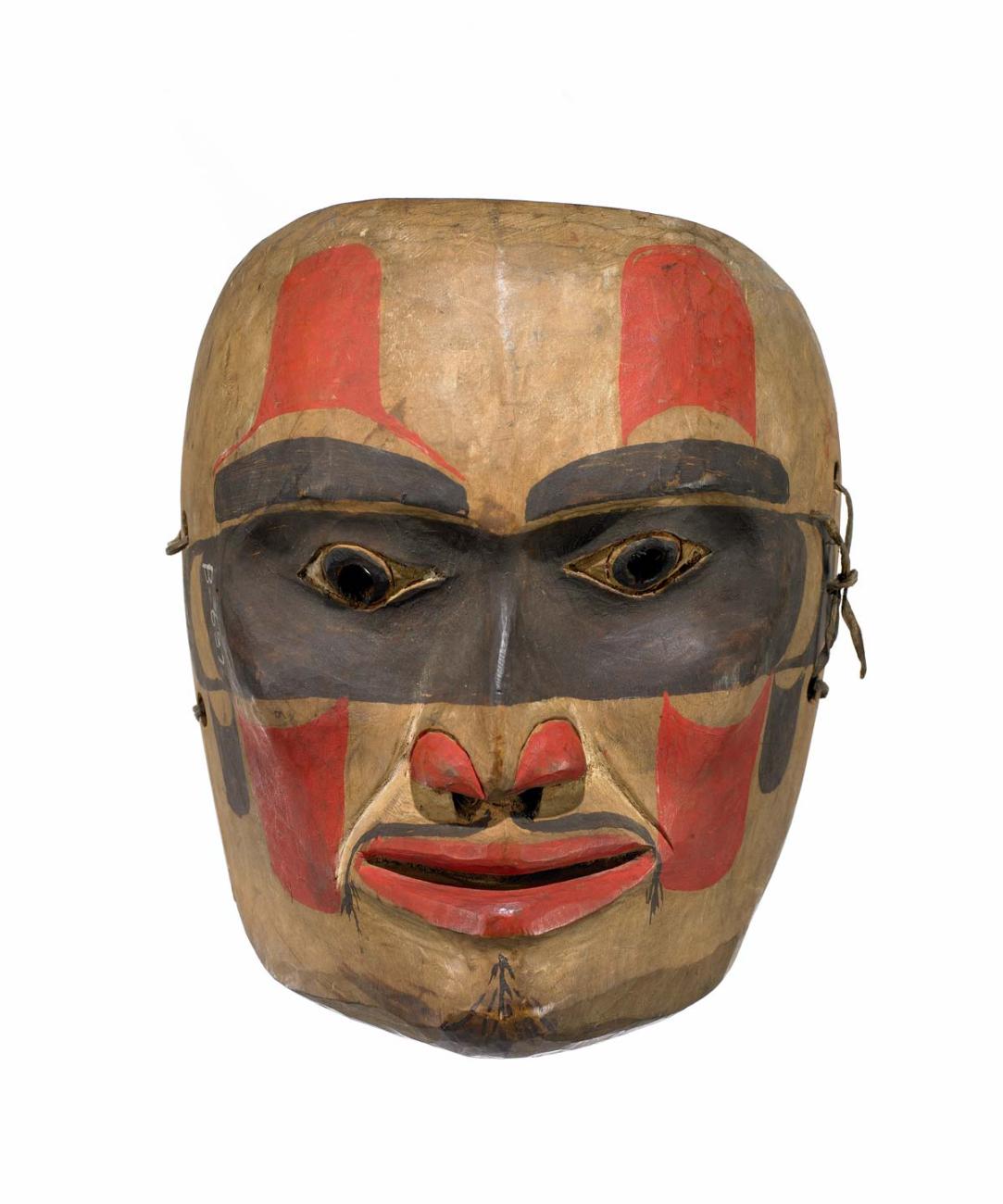
Tsimshian masks such as this were often worn during dance ceremonies.
Mask (“Ameelg”), collected in 1912; wood and paint; 8.9". NMNH E274242
Photo by Donald E. Hurlbert, Smithsonian Institution
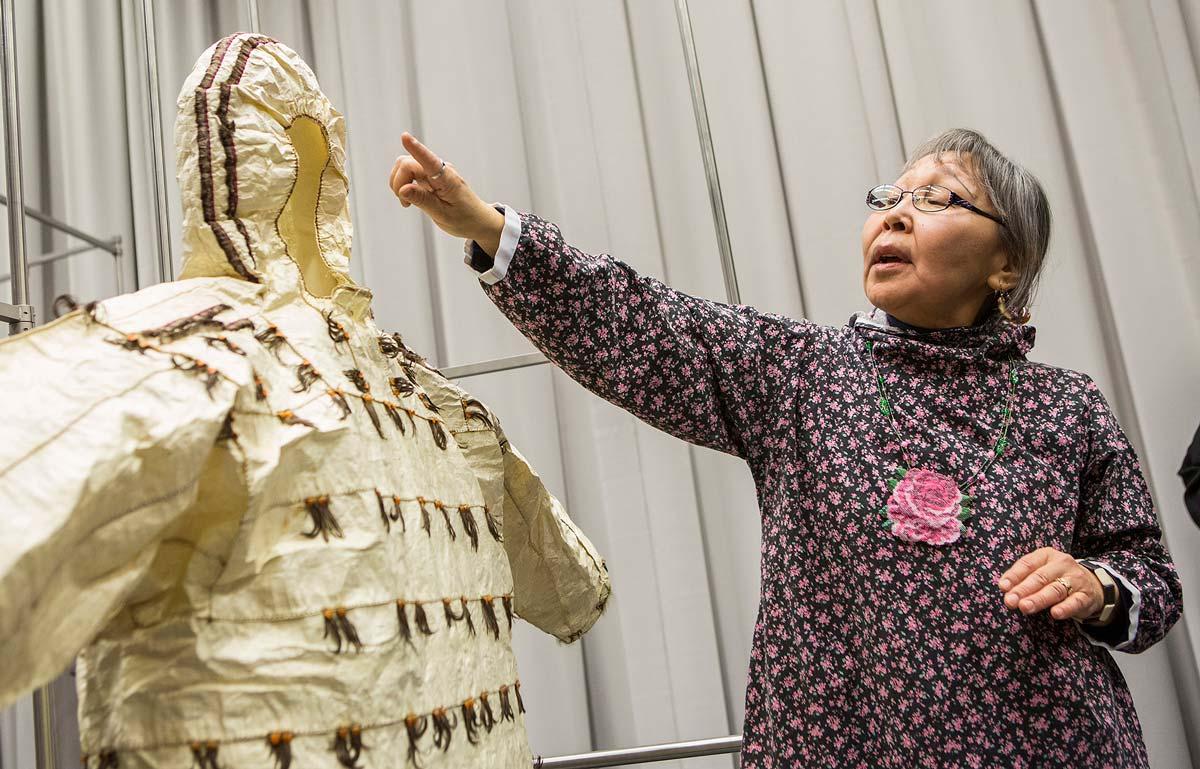
Elaine Kingeekuk (St. Lawrence Island Yupik) talks about the sea mammal intestine and other materials that were used to create this parka.
Sanightaaq ceremonial parka; collected in 1923; sea mammal intestines and fur tassels; 48.8". 12/3404
Photo by Donald E. Hurlbert, Smithsonian Institution
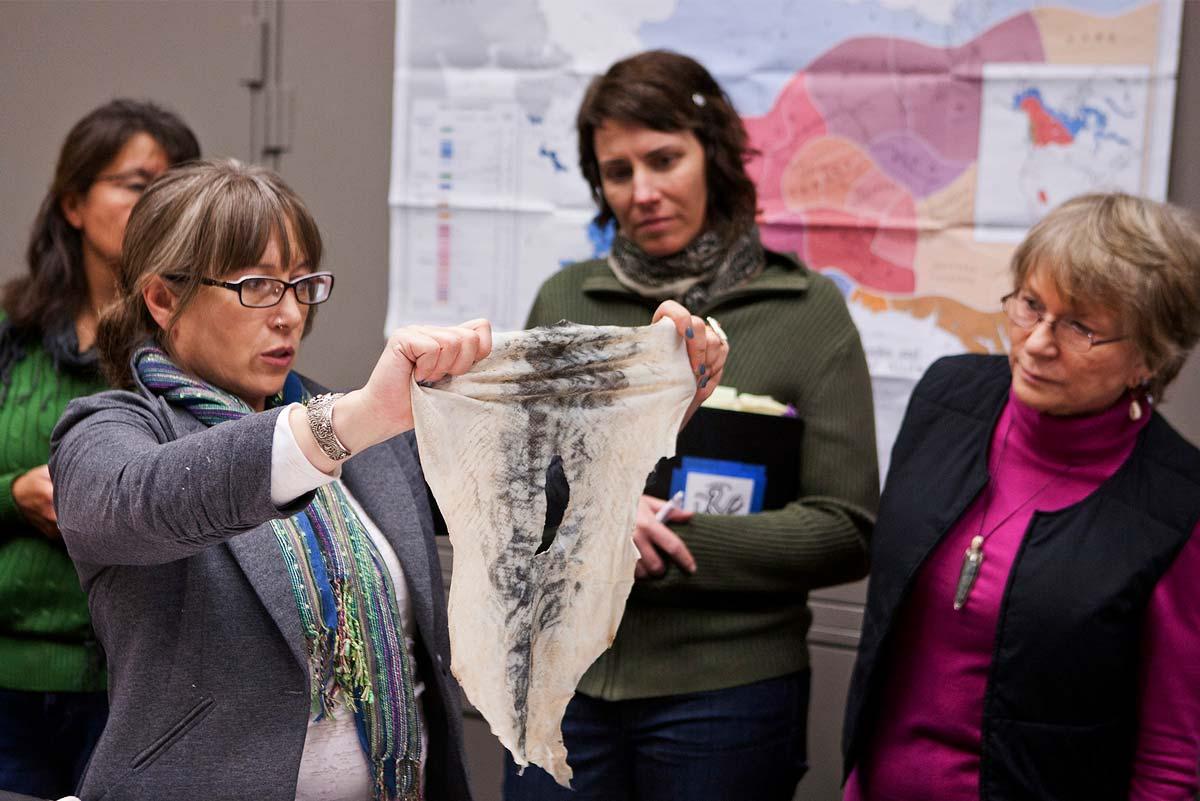
NMAI’s Head of Conservation Kelly McHugh (middle) and other workshop attendees listen to Sugpiaq artist Coral Chernoff, who was demonstrating how to tan salmon skin.
Photo by Wayde Carroll, Courtesy of Arctic Studies Center
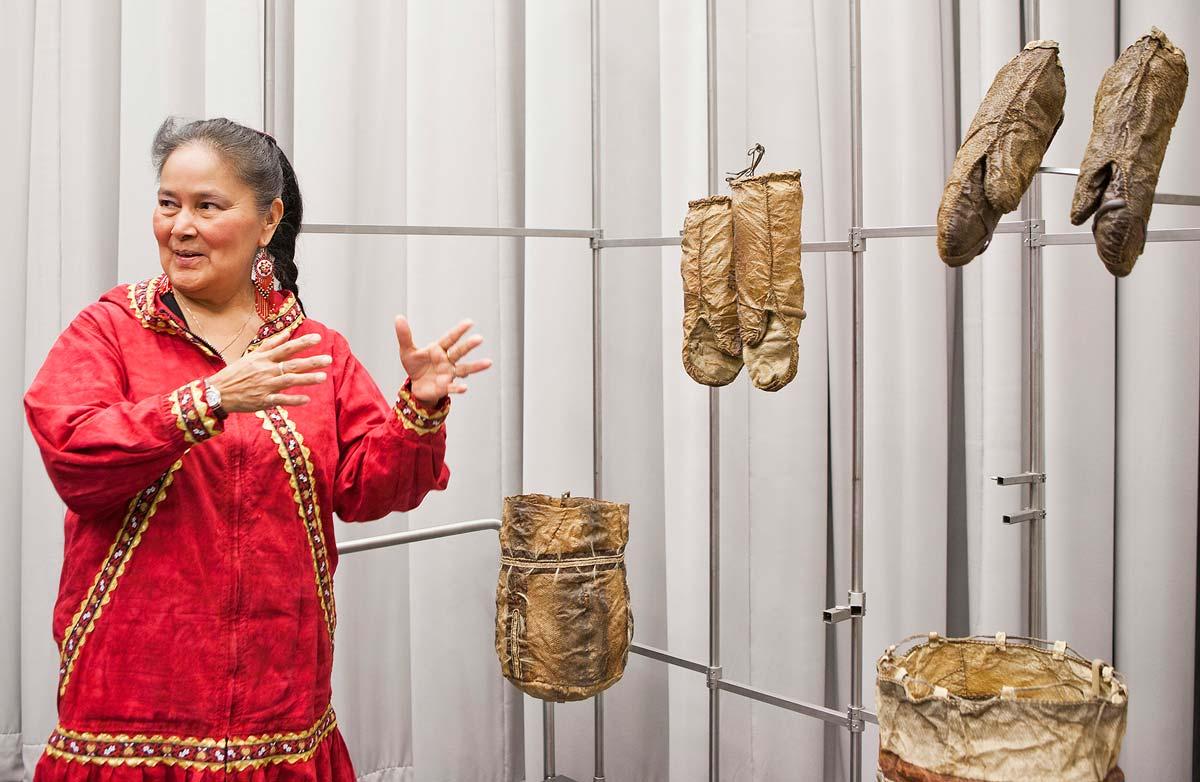
Koyukon Athabascan artist Audrey Armstrong talks about salmon skin gloves and bags during a workshop held at the Arctic Studies Center.
Photo by Wayde Carroll, Courtesy of Arctic Studies Center
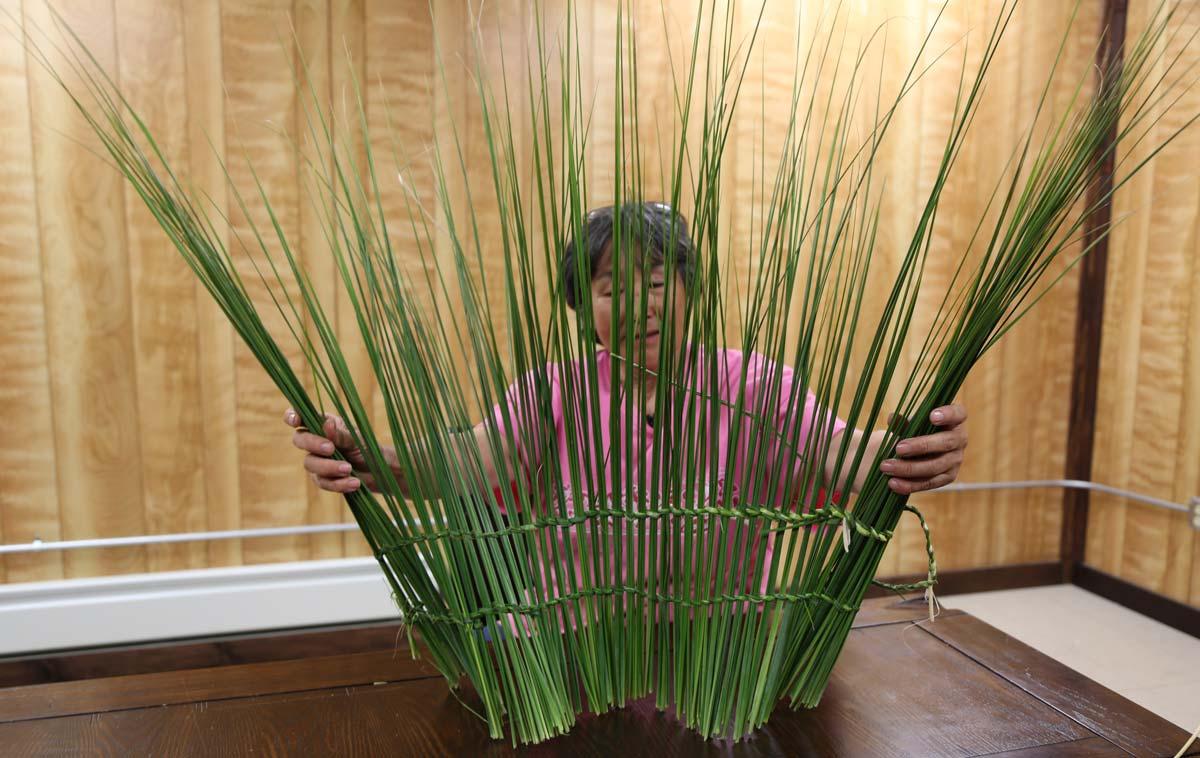
In videos offered through the Smithsonian Learning Lab website, Yup’ik culture-bearers and students demonstrate how to harvest, process and twine “taperrnaq” (coarse seashore grass) into baskets such as this one.
Photo by Jacki Cleveland, Courtesy of Arctic Studies Center
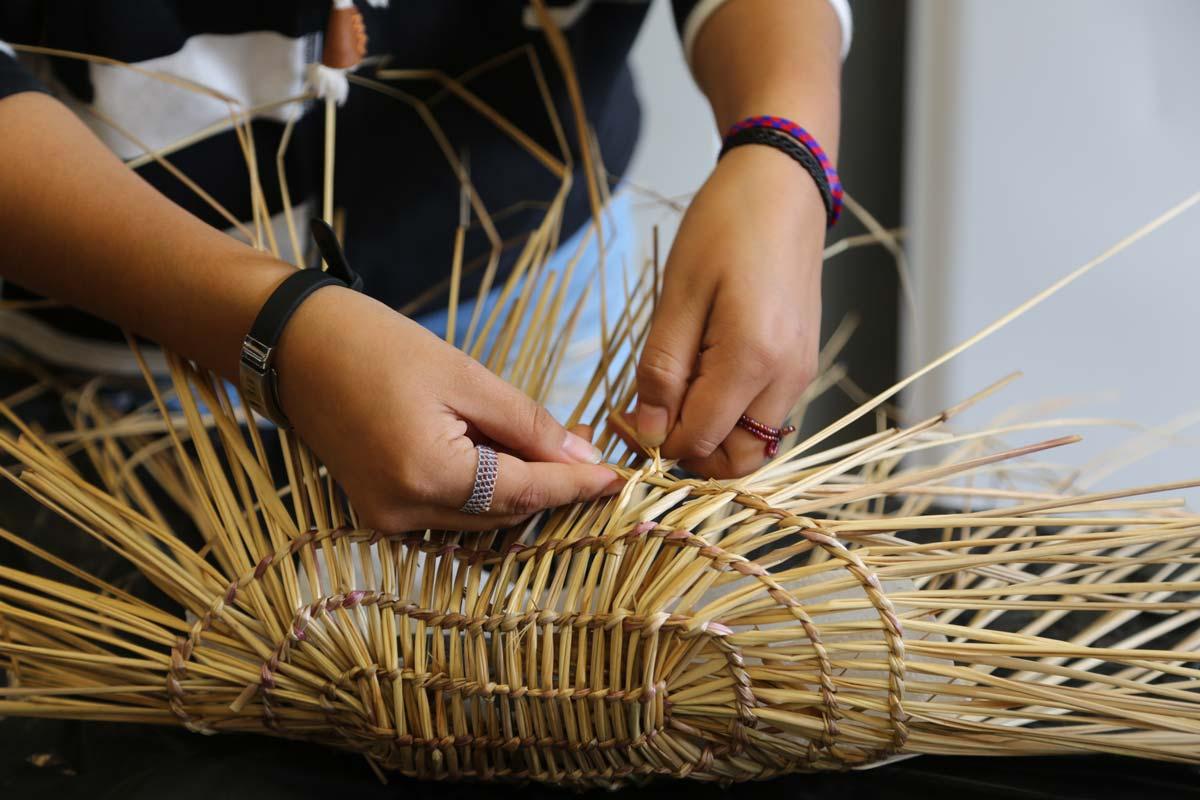
In videos offered through the Smithsonian Learning Lab website, Yup’ik culture-bearers and students demonstrate how to harvest, process and twine “taperrnaq” (coarse seashore grass) into baskets such as this one.
Photo by Jacki Cleveland, Courtesy of Arctic Studies Center
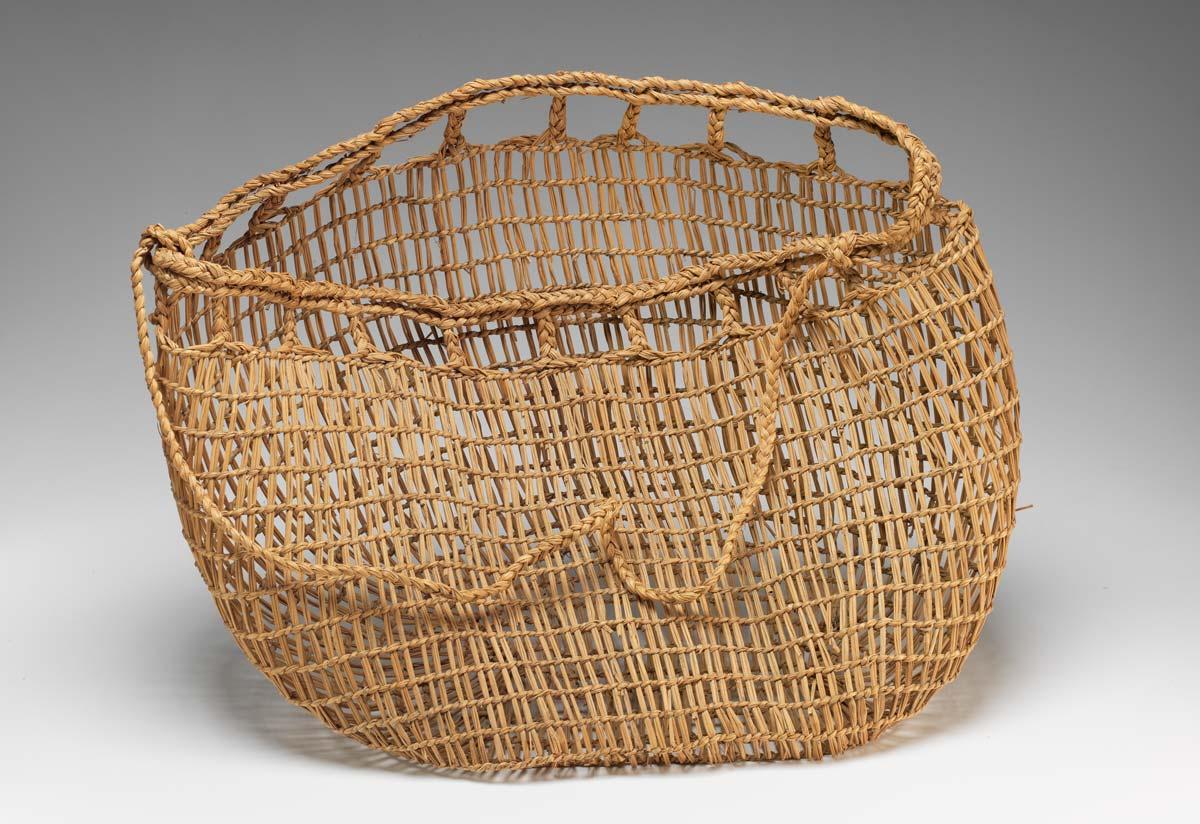
In videos offered through the Smithsonian Learning Lab website, Yup’ik culture-bearers and students demonstrate how to harvest, process and twine “taperrnaq” (coarse seashore grass) into baskets such as this one.
Yup’ik grass bag, Betty King (Cup’ik), circa 1965; rye grass; 18.9" x 16.9" x 6.3". 26/9160
Photo by Jacki Cleveland, Courtesy of Arctic Studies Center
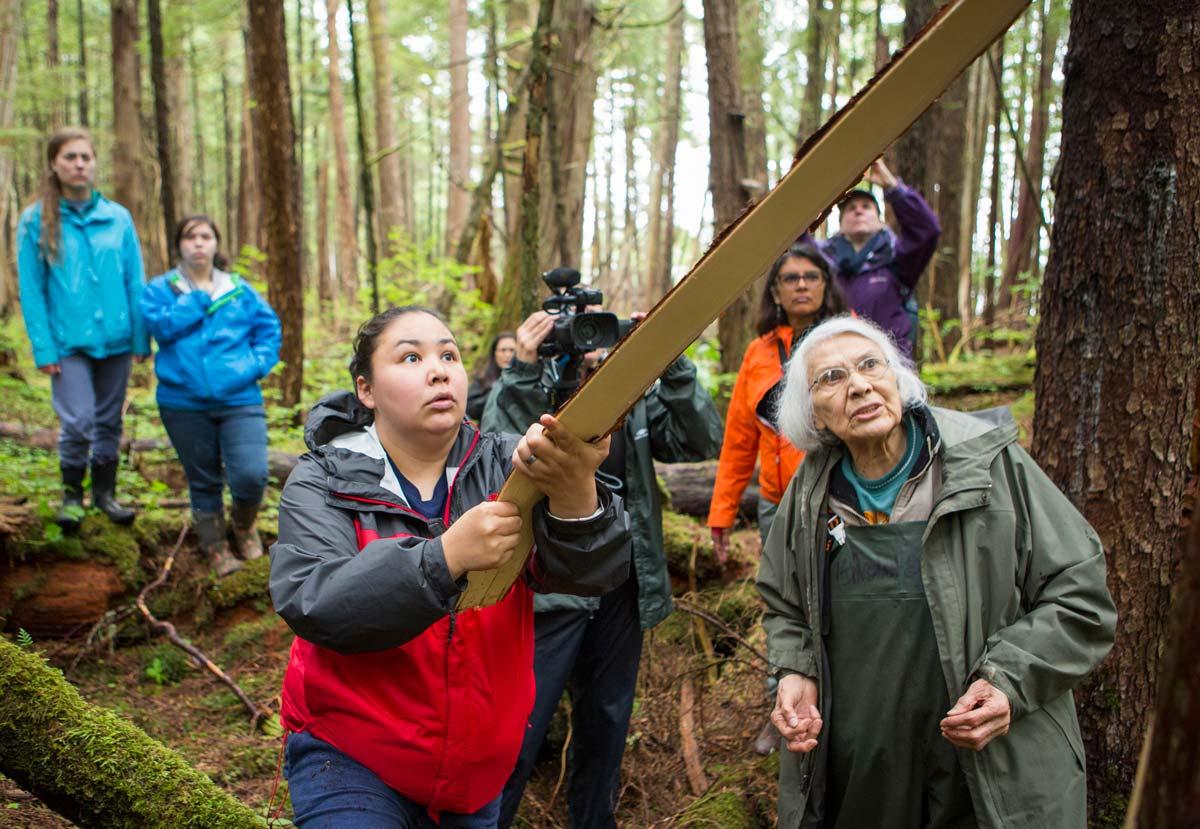
In 2016, the Arctic Studies Center collaborated with The Haayk Foundation to document the materials and techniques of cedar bark basketry. The project included the harvesting and processing of cedar bark.
Photo by Wayde Carroll, Courtesy of Arctic Studies Center
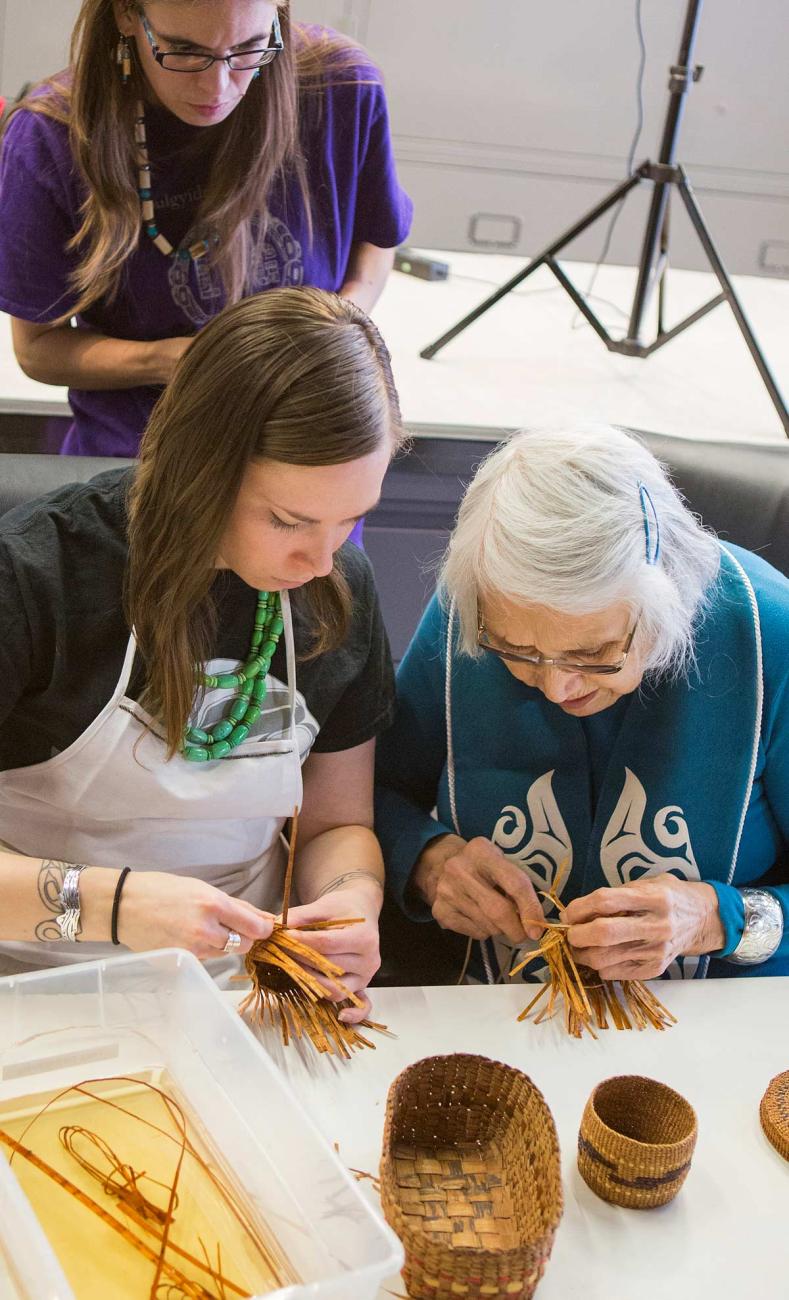
It also included a weaving workshop in Metlakatla and a residency at the Arctic Studies Center, where artists studied baskets from museum and personal collections.
Photo by Wayde Carroll, Courtesy of Arctic Studies Center
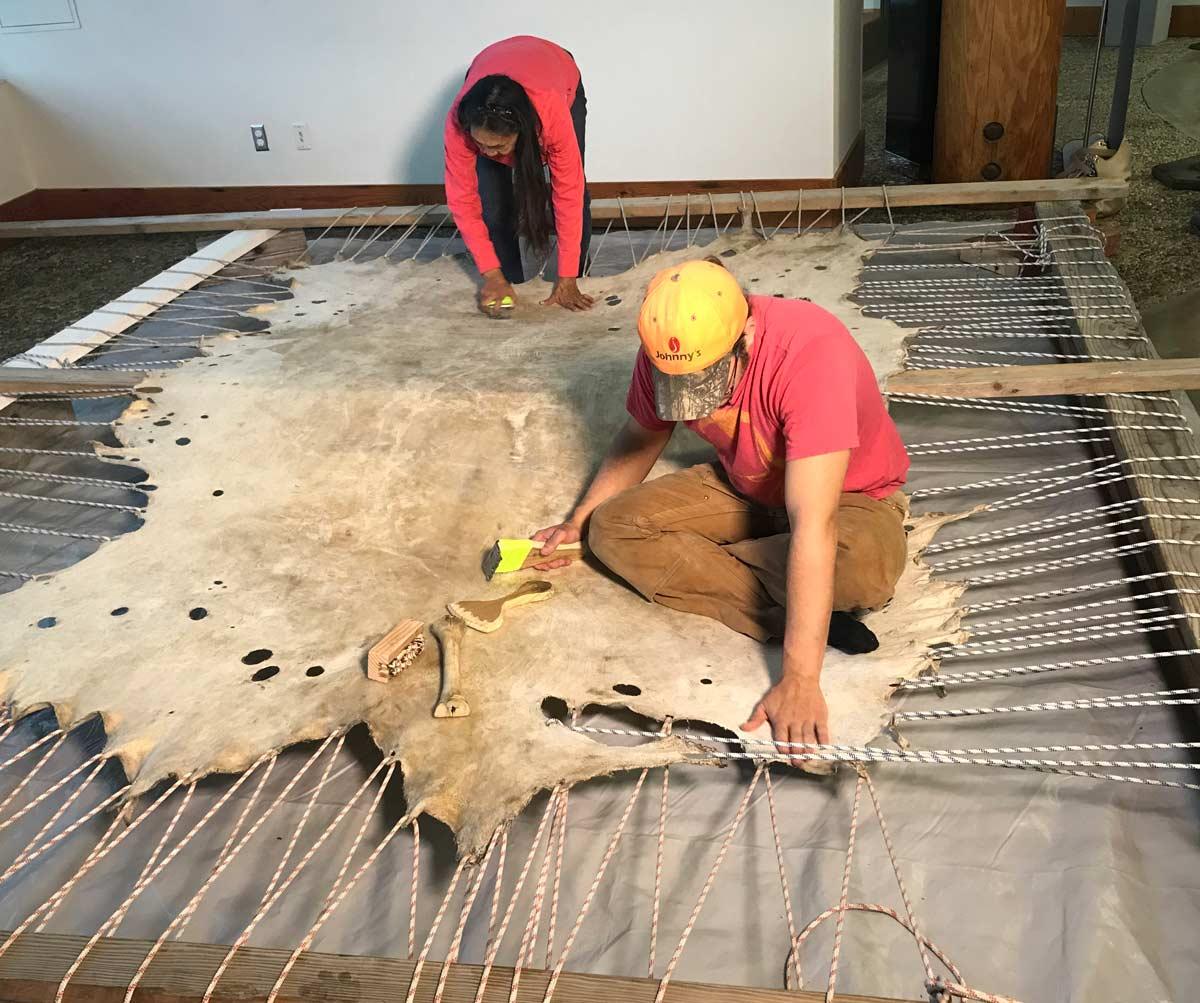
At a community workshop, Helen Dick MacLean (Dena’ina) and Joel Isaak (Kenaitze) stretch out a moose hide during its multistep tanning process.
Photo by Wayde Carroll, Courtesy of Arctic Studies Center
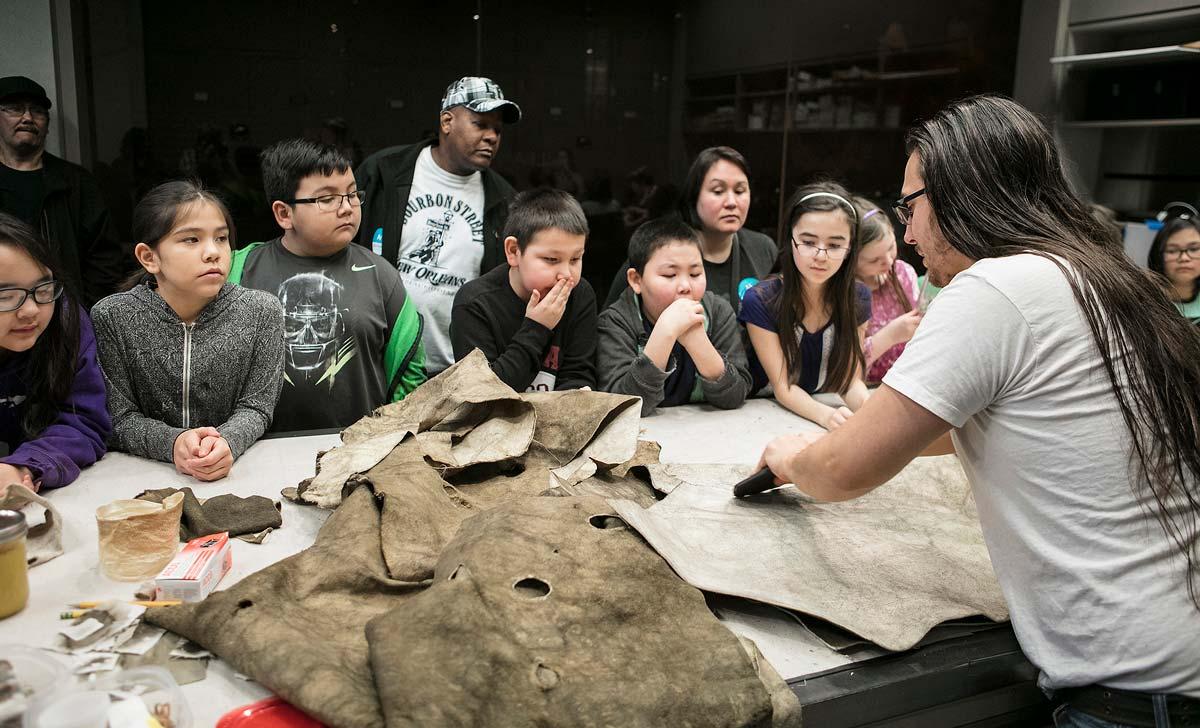
Isaak talks about tanning techniques to students from a local school visiting the Arctic Studies Center.
Photo by Wayde Carroll, Courtesy of Arctic Studies Center
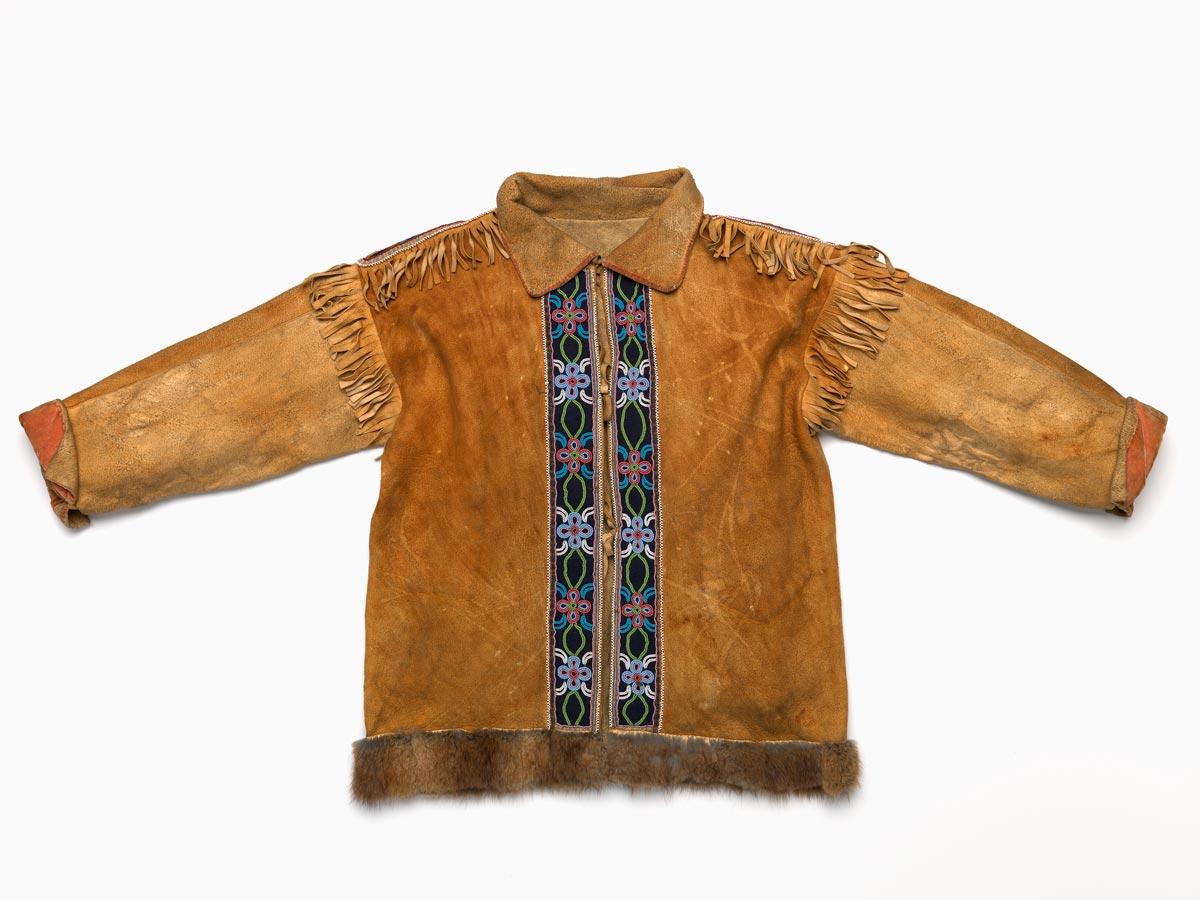
On special occasions, Athabascan leaders and other influential people may wear beaded moose-hide jackets such as this known as “chiefs’ coats.”
Chief’s coat (“Deniigi zes dghaec”); Ahtna Athabascan; circa 1890–1910; moose hide, beaver fur, cotton, wool and glass beads; 32.3" x 58.7" x 3.5". 21/4801
Photo by NMAI Staff
These items of the “Living Our Cultures, Sharing Our Heritage: The First Peoples of Alaska” exhibition have been on display at the Anchorage Museum from the Smithsonian’s National Museum of the American Indian and National Museum of Natural History (NMNH) since 2010. “This is one of the largest and longest exhibition loans in the history of the Smithsonian,” said Dawn Biddison, a museum specialist at the Arctic Studies Center. She and Kelly McHugh, head of Conservation at NMAI’s Cultural Resources Center in Suitland, Maryland, worked with Alaska Native peoples who selected and helped prepare the items for shipping and placing the items on display—a process that began years earlier. “I think one of the hardest things about working with collections is they are often so far away from their people and places. So, this felt really great, getting [the items] closer to their home,” said McHugh.
Unlike many other museums’ exhibitions about Indigenous heritage that display items sealed behind glass, the goal of the loan was for Alaska Native peoples and tribes to be able to not only view but interact with their cultural belongings. The items on display here are continuously in use by members of Alaska Native communities. They are, in essence, engaged in an ongoing conversation with elders, artists and others whose ancestors created them.
Listening to a Collection
Part of the NMNH, the Arctic Studies Center in Alaska provides access to Smithsonian collections as part of its collaborations with Indigenous communities. The items from the NMAI and NMNH on display at the Anchorage Museum have been co-curated by the Arctic Studies Center and Native community members. The museums wanted them to be able to inform Smithsonian staff how to properly care for these items and be able to show through the exhibition that “cultural items have a life,” said McHugh. “It was a highly collaborative project. In one case, I had to work on a gut parka that was torn and needed to be repaired. I was put in touch with Elaine Kingeekuk (St. Lawrence Island Yupik) who said that adhesives will fail. So, she came to do the repair here [at the NMAI’s Cultural Resources Center]. Watching her handle the gut and use minke whale sinew to sew it was impactful in ways I can’t describe. For her, a failed repair means your loved one freezes to death.”
In another instance, McHugh recalled, Tsimshian artist and dance group founder David Boxley helped update the information about some masks in the collection. She said he “could look at some of the masks that were labeled Tsmishian but were not. He could identify characteristics you would see in these hundreds-of-years-old masks, these visual indicators of cultural traditions. He was educating us to better understand what we were caring for.”
In response to direction from Indigenous consultants, the “Living Our Cultures” exhibition is organized by cultural groups geographically from north to south along the gallery hall, with each side of the 10-foot-tall cases displaying the cultural belongings of a particular Alaska Native people. Of the United States’ 575 federally recognized tribes, 229 are Alaska Native communities. Represented here are the Iñupiaq, Eastern Siberian Yupik, St. Lawrence Island Yupik, Unangax̂, Sugpiaq, Yup’ik, Athabascan, Eyak, Tlingit, Haida and Tsimshian.
Among the many items on view are snowshoes and snow googles; gloves with porcupine quills; a bowhead whale amulet; eagle, salmon and killer whale headdresses; finely adorned parkas, caribou and moose jackets; canoe models; dance tunics, fans and masks (including one of an owl whose beak opens and closes); a child’s fluffy arctic hare parka and pants; sleds; and far more to catch one’s attention.
“We have traditional items blended with the modern. You say if it looks like a rifle or beautiful Athabascan moose hide gun case or metal boat or binoculars, it’s not traditional life. But no, we’re just adapting things,” explained Paul Ongtooguk (Iñupiaq), retired director of Alaska Native Studies at the University of Alaska Anchorage and one of the editors of the exhibition’s 312-page catalogue published at the time the exhibition opened in 2010. One example he cited was what he said his Iñupiaq people refer to as a “seal scratcher”—a tool made from four bearded seal claws lashed to a wooden handle that is used to scrape the ice to calm wary seals as a white-clad hunter crawls toward them. “Now we use a steel knife blade, but knowing how to use the blade, that’s traditional knowledge. You scrape it toward yourself while holding the blade horizontal in your hand to get that same sound of a seal.”
What those planning the exhibition wanted to avoid is “a static display that says this is a fascinating object that represents a static culture or cultures that are vanishing,” he said. “What we wanted to show instead is that these materials and the cultures they’re a part of are rich, they’re dynamic and they’re continuing to move forward.”
Items that Teach
The “Living Our Culture” exhibition display cases are uniquely designed. The area can experience earthquakes, and if one occurs, the rods in the cases are able to vibrate at different frequencies so as not to bump into each other. In addition, the items in the cases are mounted on brackets, and upon request of Native visitors, can be taken out. They are then reattached to holders on a special cart and wheeled into the museum’s “community room” where they can be more closely examined.
“Some museums were very restrictive to people like me who wanted to see and touch and examine pieces but depended on people maybe not from our culture as stewards of collections that really belonged to us,” noted Boxley. In addition to consulting on collection items, he contributed one of his own masks to the museum. He also provided descriptions of items in the exhibition’s catalogue, including that of a classic red, brown and black-banded Ameelg mask made by a Tsimshian artist. “We’ve helped put things on display that are relevant and beautiful,” he said.
“I’m kind of awestruck when I go there,” said Alice Rearden (Yup’ik), a language expert and storyteller who wrote the introduction for the Yup’ik section in the exhibition catalogue. She said being able to touch the items in the collection makes “you feel a connection and pride. You can look at an object and can’t imagine the process of making it till you hear an elder tell the story while holding the object. And then if you ask them how it was created and what it was used for, you get information that could have been lost. That’s why it’s so important to have that access to the materials.”
These items have also been part of several workshops about customary arts held at the museum. In 2014, Kingeekuk and two other Alaska Native artists joined an exhibition residency in Anchorage, teaching conservators and Native art students how to clean, scrape, inflate, dry cut and sew seal intestines to create lightweight parkas. One example is the exquisite St. Lawrence Island Yupik snow-
colored ceremonial gut parka on loan from the NMAI that is decorated with plumes and beak parts from crested auklets. The exhibition also features an online video of Kingeekuk demonstrating her gut-sewing skills, starting with the soaking of the intestines. “When you’re soaking them” she explains in the video, “you need cold, cold water and snow in there. Ice cold water is the natural way of getting rid of the smell.”
“What I really like about the exhibition is it feels like home in a respectful way. When you enter the space with the benches and videos you can sit and watch an interpretation of what you’re seeing without a ton of reading. Like, you’re seeing clothing and quill work that’s visually coded information,” explained Joel Isaak (Kenaitze), an artist and the operations director for the Kenaitze Indian Tribe. “You can see and know where people are from by what they wear,” he said. The exhibition “presents us as a living people.”
His own art includes bronze sculptures, installations, fish skin clothing, birch bark basketry and moose hide work. He learned to process traditional materials from elders such as Helen Dick MacLean (Dena’ina) as well as studying from Dena’ina collections around the world, including the Smithsonian collections.
He and other Indigenous visitors have been able to closely examine and enrich the Smithsonian collections’ information when, for example, items made from salmon skin were taken out of their cases for a workshop in 2012. At that time Isaak was able to identify that the thread used to sew a pair of mittens was made of salmon skin rather than animal sinew as it had been labeled. “It [the salmon thread] expands and contracts at the same rate of the skin you’re sewing so makes for tighter seams. It fills in the hole the needle makes,” he explained. Working with traditional material such as salmon skins also has allowed him to relearn some knowledge such as the fact that, despite where the fish live, salmon skin boots are water repellant but not waterproof.
Another example of learning traditional knowledge anew is presented in a video of Helen Dick MacLean teaching Isaak the up to 20-step process for tanning moose hide. Isaak said just one hide can require “a month of hard labor of 8- to 12-hour days.”
Along with the sewing gut, salmon skin, moose hide and other workshops the Arctic Studies Center has hosted and the other videos it has produced, it has produced 11 videos for an extensive “issran” or grass carrying bag workshop. This was conducted at the Nunalleq Culture and Archaeology Center in the 770-member Yup’ik village of Quinhagak on western Alaska’s Bering Sea, a community known for the ancient Yup’ik cultural items that have been found near there. Lead Yup’ik artist Grace Anaver, with guidance and assistance from her sisters Pauline Beebe and Sarah Brown, provided detailed instruction and field demonstrations on how to collect, process and dry the coarse seashore grasses needed and then twine and weave them into traditional issran similar to bags in the exhibition.
The center has also offered workshops and produced a 15-part video series about gathering and weaving red cedar bark. The recordings feature Indigenous women weavers who gathered in 2016 to teach and learn red cedar bark basketry techniques of the Metlakatla Tsimshian people. At the same time red cedar bark has become harder to collect due to historic logging and other environmental factors. In one video, Haida master weaver Delores Churchill recalls during the 1970s,“The Tsimshian woman I learned from, she came to take my mother’s class and here she was weaving and her fingers were moving so fast and I said, ‘Flora [Mather] why are you in this class?’ and she said, ‘because I don’t have any red cedar bark. I need cedar bark, and I knew I’d get it in this class.’ So as soon as she went out the door, because I didn’t want my mother to know what I was saying, I said, ‘Flora, can I learn Tsimshian weaving from you?’”
Reaching Across Miles and Generations
Given that many Indigenous communities are widely scattered across the large state of Alaska and can only be reached by boat or plane, the museum also offers online resources that facilitate regular access to the items for people who cannot make it to Anchorage. A number of videos posted online through the Smithsonian Learning Lab website (learninglab.si.edu) have helped inform community projects across the state teaching new generations traditional skills. In these recordings, Indigenous elders and other experts speak (some in their Native languages with English subtitles) about their peoples’ histories as well as about tool construction, hunting, fishing, weaving and other customary practices.
NMAI’s Alaska Outreach and Engagement Specialist Melissa Nenantaxnen Shaginoff (Chickaloon Village, Pyramid Lake Tribe) emphasizes the importance of both in‑person and virtual engagement opportunities offered through the Arctic Studies Center. While online access can be valuable, she notes that certain forms of cultural knowledge must be experienced firsthand. “Oftentimes, collections have something to teach us that cannot be anticipated when viewed online or in a publication. Interacting with collections in person helps us honor the life embedded within them, the life given to us by the animals and materials represented in each item. As museum professionals we must ask ourselves, ‘How do we reframe a collections purpose to align with each community’s cultural values and protocols?,’ ‘Can a collection item be a teaching tool, as moment of connection, a facilitator for the transfer of our cultural knowledge?,’ and, ‘How can we make sure that it is Indigenous communities defining and leading this work?’”
The exhibition and the Learning Lab resources are also inspiring younger visitors. Alice Rearden, who contributed to the exhibition catalog, was also a former high school teacher in the town of Bethel and now is the cultural engagement manager at Calista Education and Culture in Anchorage. She appears in “Living Our Cultures” videos and on its website. “My students would go to Anchorage with their parents and call me to say, ‘We saw you at the museum ,Cucuaq! [her Yup’ik name],’ or they’ll see me on the website and, oh my gosh, the students love the videos. They really enjoy them and pay attention, and I like that they include a young person and an elder [in several of the videos] because that helps to promote learning for young people,” she said. “It encourages them to learn more about the objects … as many of the objects are still very much a part of our lives.”
While working on the exhibition, Rearden also learned language from elders who described items in her Native Yup’ik language she had not heard before. She was amazed to “see the objects and for example [seeing an elder] describing a seal harpoon [they’d used] on the river and using high-level Yup’ik language describing parts of the harpoon that could have been lost because that material culture was gone. Our ancestors are ingenious, and we still carry that knowledge and those processes and are still amazing craft people and problem solvers,” she said. “This [exhibition] shows our cultures are still living as we are still trying to adapt to our environment today.”