
Steven Tamayo is a man of many talents. Some know him as a traditional Sicangu Lakota artist who can do everything from tanning buffalo hides to sewing delicate feathers and glass beads onto regalia. Those who have learned time-honored techniques from him call him their teacher. Still others know him as a storyteller, a painter or a digital artist.
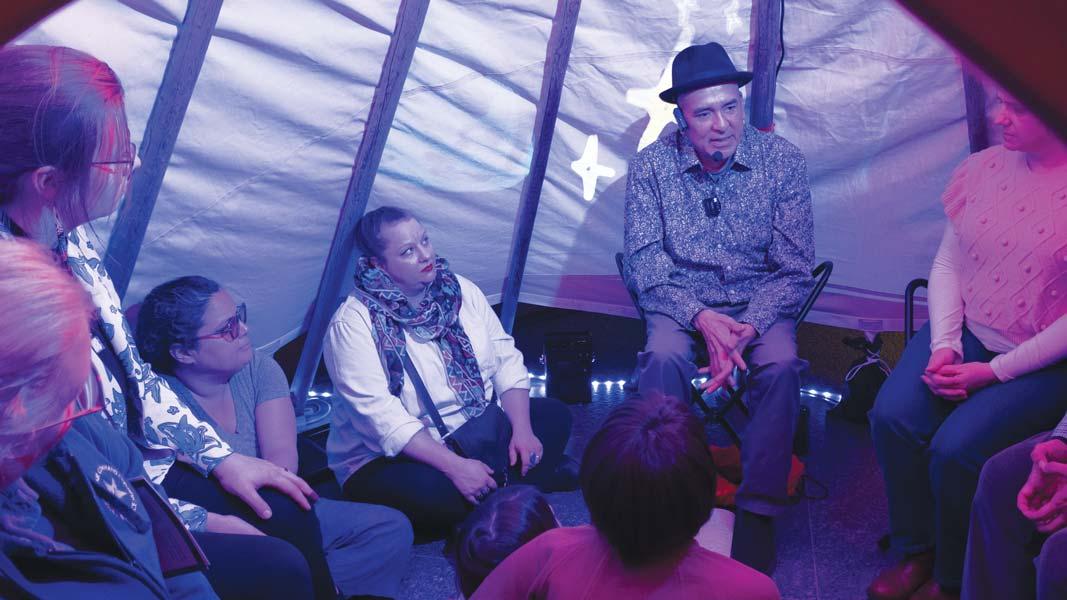
Traditional artist Steven Tamayo tells creation stories while his art is projected behind him at the at the Joslyn Art Museum in Omaha, Nebraska.
Photo courtesy of Steven Tamayo.
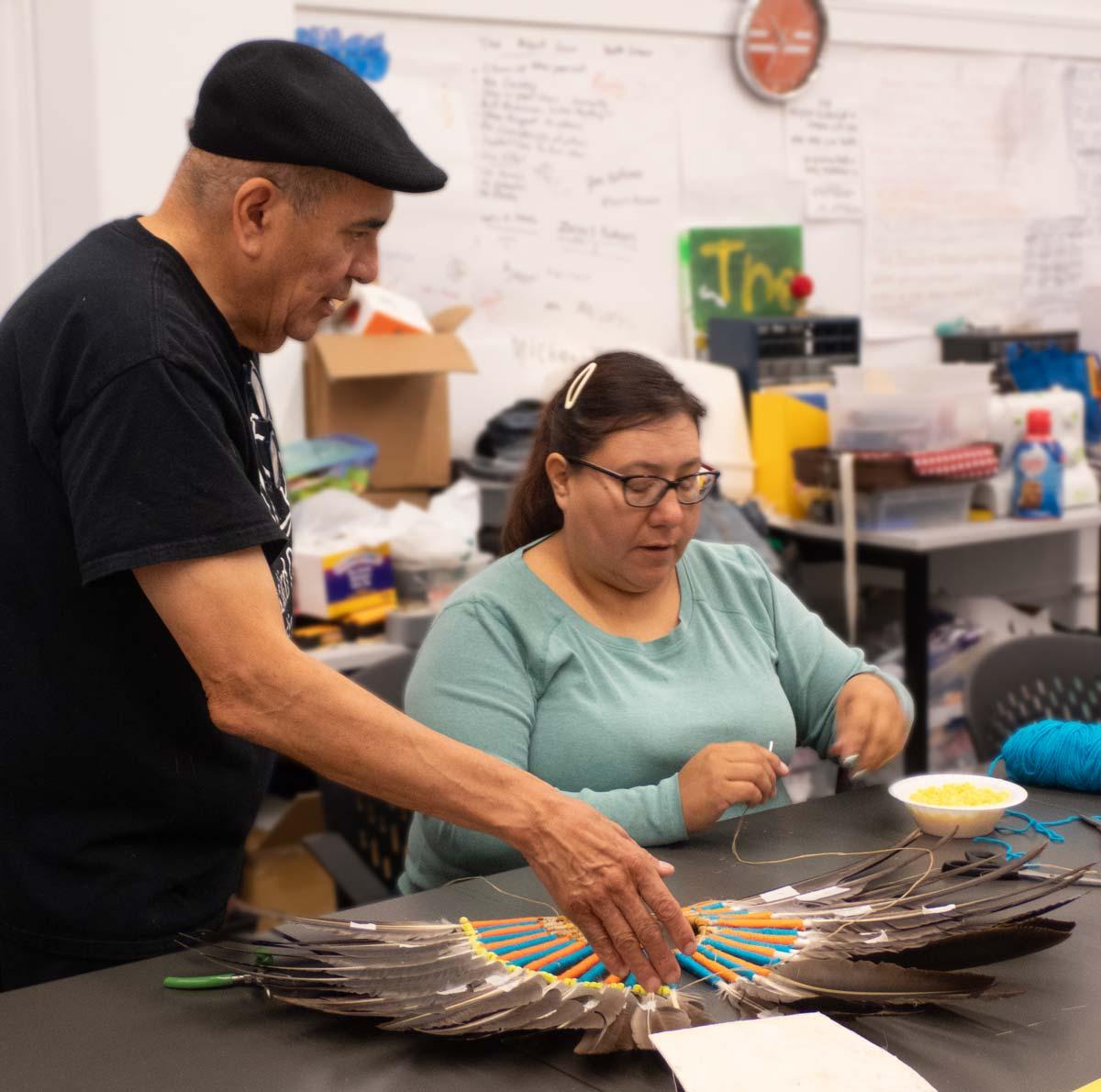
Tamayo teaches bustle making and other traditional arts at his organization, the Bluebird Cultural Initiative in Nebraska.
Photo courtesy of Steven Tamayo.
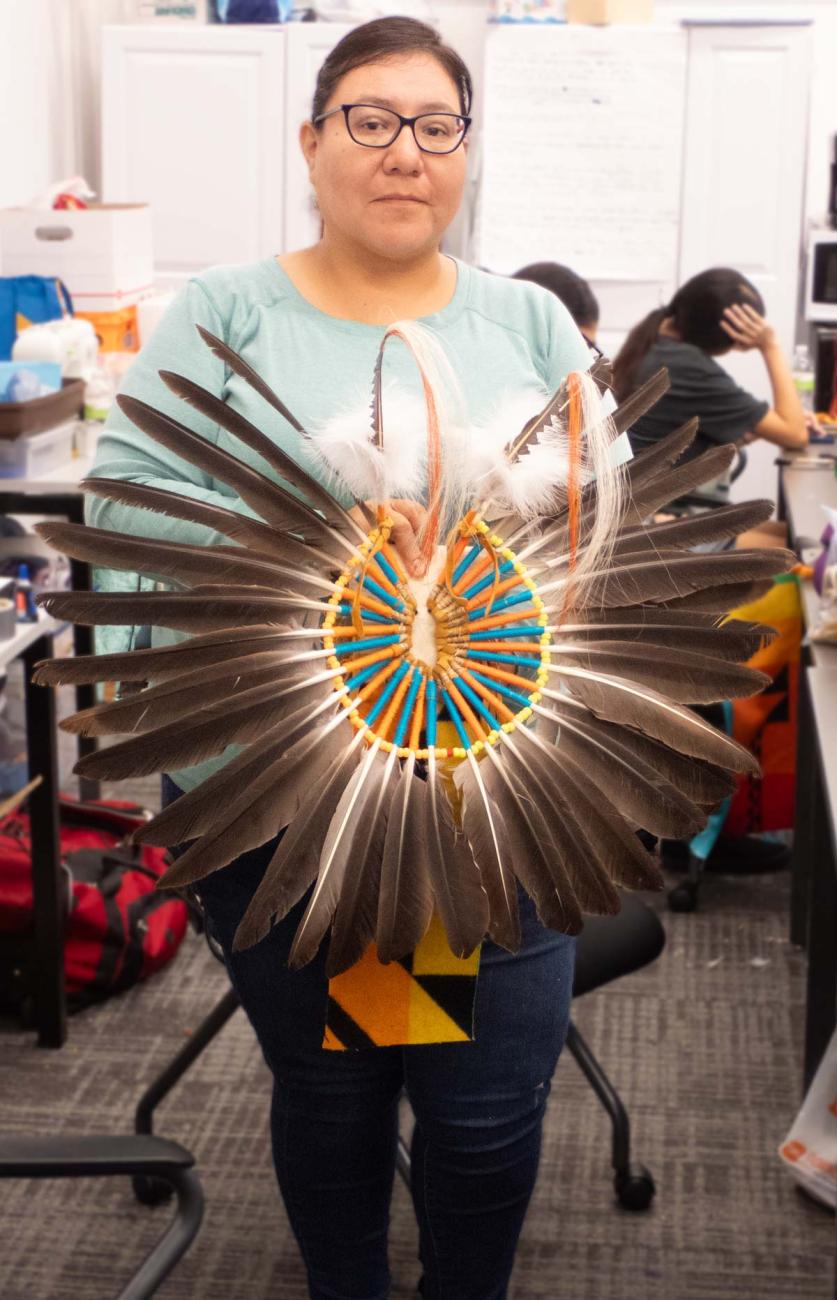
Lakota artist Amorette Bullhead holds her completed bustle, which would be worn on the small of a dancer’s back.
Photo courtesy of Steven Tamayo.
In September 2025, this multifaceted artist and mentor received a Bess Lomax Hawes National Heritage Fellowship award from the National Endowment for the Arts (NEA)—one of the highest honors in the folk and traditional arts in the United States. “Art is my savior,” he said in a NEA video tribute to him. “It is my reconnection to who I am.”
This was just the one of the honors he has received and notable projects he has worked on during his career. In 2014, he gifted buffalo hide robes to Willie Nelson and Neil Young while they were at the Dakota Access Pipeline protests in Standing Rock and he created a tipi that was presented first to former U.S. President Barack Obama before it became part of the National Museum of the American Indian collection. In 2022, Tamayo received a Creative Capital Award, a grant that enabled him to create 13 buffalo robes, one of which has been displayed in the Library of Congress. He was also chosen to be one of the beaders for Lily Gladstone’s 2024 Academy Awards gown, which was on display at the museum this past year.
Tamayo’s journey to becoming the leading artist and educator he is today started at an unlikely place. After serving in the U.S. Army in the 101st Airborne Division, Tamayo returned home to Council Bluffs, Iowa, in 1987 as a single father and took the only job he could find—working at a meat packing plant. In 2000, he moved his family to the Rosebud Reservation, home of the Lakota peoples in south-central South Dakota. There, he used his experience with animal hides at the plant to learn from elders how to tan those of the buffalo raised on tribal lands and craft them into traditional robes.
He decided to pursue a Bachelor of Fine Arts degree from Sínte Gleska University in Mission, South Dakota. After graduating in 2011, he developed Native art curricula that he taught at the school. In 2014, he received the Nebraska Arts Council’s Governor’s Art Award for excellence in cultural artistic expression.
The NMAI has long been aware of Tamayo’s many skills. One day about 20 years ago, he was tanning a buffalo hide in his front yard when he was visited by a NMAI staff member who invited him to be an intern at the museum. At NMAI and even after his internship was completed, he consulted on several exhibitions that featured traditional Native clothing, including 55 Native dresses for the exhibition titled “Identity by Design.”
Kelly McHugh, head of conservation at the NMAI, said Tamayo is “the embodiment of Indigenous values.” She said, “He’s been real instrumental in teaching us. It’s always been this amazing exchange.”
The regalia work perhaps closest to his heart is making bustles. Men wear bustles—which are made of eagle, hawk or other feathers spread in a circle like a turkey tai—on the lower back of their dance regalia. While he was at the Rosebud Reservation, Tamayo said, “I came across the Lakota bustles. That just kept my curiosity going.”
He began working with Howard Wolf, a World War II veteran and Umoⁿhoⁿ (Omaha) elder. Tamayo studied a variety of traditional artforms under Wolf’s direction, including the Xaxe’, or Crow belt—a bustle consisting of conical rows of raptor feathers and a stuffed crow attached to its backboard to show prowess in war. “He explained that this crow belt was one of the highest honors of the Omaha people,” said Tamayo.
So when Tamayo returned to the NMAI as artist fellow last fall, he extensively studied bird feathers and 16 different types of bustles as well as bird feathers in the collections of the Smithsonian’s National Museum of Natural History and the NMAI.
As part of his NMAI fellowship, Tamayo has been teaching bustle making to artists in Indigenous communities on the Rosebud Reservation and in Lawrence, Kansas, as well as through his nonprofit organization Bluebird Cultural Initiative in Omaha, Nebraska. He will continue these workshops in other communities across the country.
As his organization’s cultural program director, Tamayo teaches Indigenous youth and young artists how to create Native regalia, tribally specific adornments, drums and bows and arrows to connect them with their Native cultures. Tamayo said he founded the Bluebird Cultural Initiative because “the elders and the kids in my community, they just don’t have that support. There are no monies allocated to help them. I can’t tell you how many items I could purchase just to help and show our kids how to make moccasins and regalia,” he said. “They and I needed an outlet.”
His daughter, Nicole Benegas, serves as the executive director of Bluebird Cultural Initiative. She said, “We reach out to a lot of very high risk youth. So within all of this work, he does a lot of education on origin and creation stories and delves into the meaning and symbology behind everything. It’s really good for [their] mental health.”
Benegas reflected, “I definitely had the privilege to grow up having such opportunities to be in cultural settings. Throughout my entire life, my father has been dedicated to teaching and learning the origin stories and traditions and how to live a good way of life and be a good relative. It definitely has impacted how I see myself and how I raise my children and
my grandchildren.”
In 2025, the Nebraska Arts Council presented the Bluebird Cultural Initiative with a Heritage Award for its excellence in preserving cultural tradition. In spite of her father receiving so many awards, Benegas said, “He’s a very humble person who has always grown up with a lot of those values. He doesn’t like to be pushed into the limelight, and he doesn’t do it for recognition. But it is very nice to see that other people acknowledge that for him.”
Tony Chauveaux, the NEA deputy chairman for programs and partnerships, said Tamayo “sustains traditions that strengthen our nation’s cultural heritage. In honoring him, we celebrate both his artistic excellence and his commitment to sustaining Lakota culture for future generations.”