
On a chilly October evening in 2024, a crowd gathered on an empty golf course in Newark, a small city in central Ohio. We positioned ourselves at the head of two 300-foot, parallel earthen berms. Tripod-mounted cameras aimed down the space between them, positioned to record a moment many of us had waited almost two decades to see. A group of Native leaders were seated in front of us. As darkness fell, our murmuring voices fell silent. Then a faint glow appeared behind the distant trees, framed precisely between those earthen walls. It gradually rose, becoming the bright, full moon.
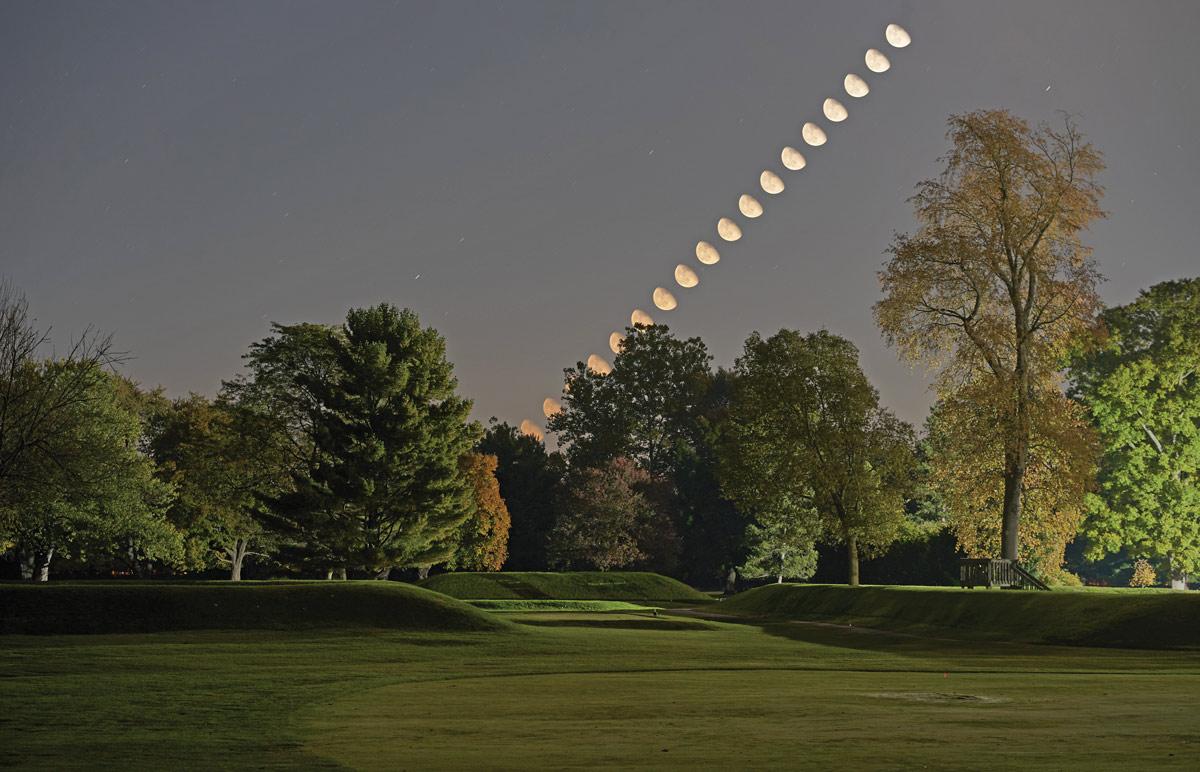
This time-lapse photo captured the moon rising above the Hopewell Octagon Earthworks in central Ohio, framed between the site’s earthen walls.
Photo by Timothy E. Black
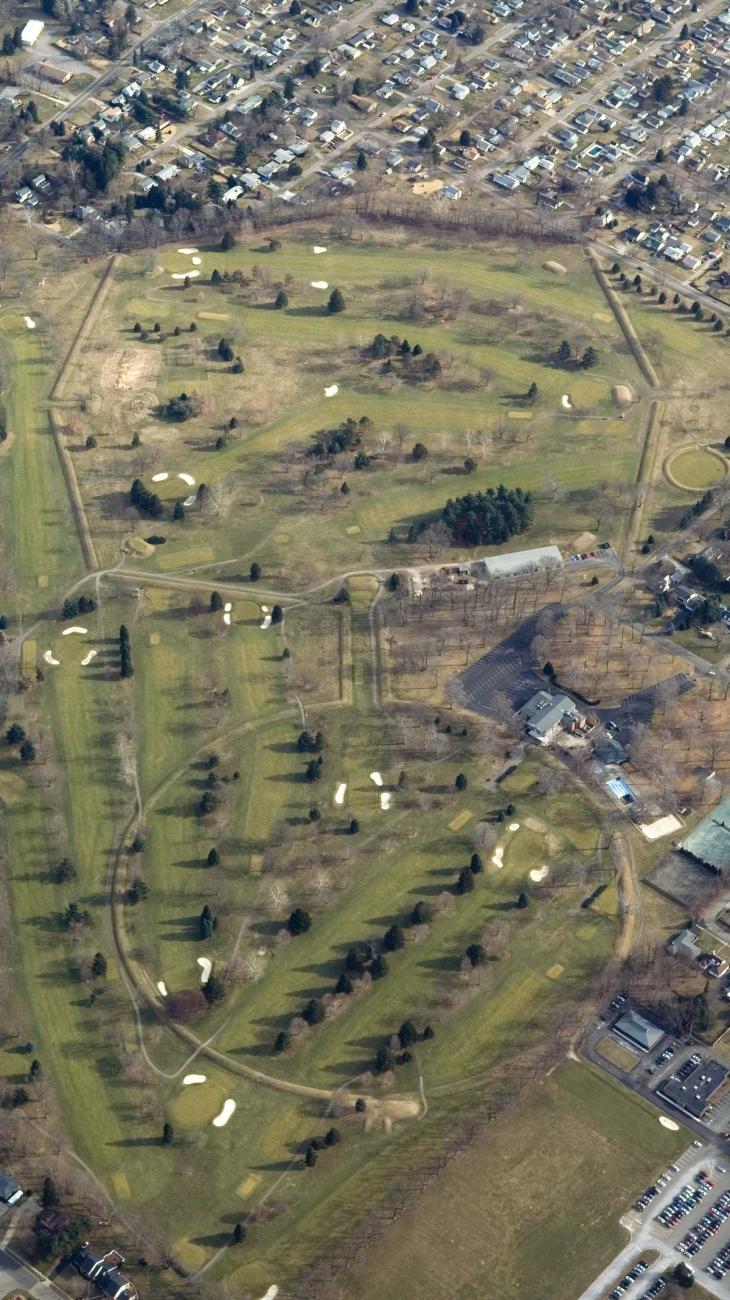
The two geometric shapes of the Octagon Earthworks in Newark, Ohio, enclose nearly 70 acres. The moonrise aligns with their long, connecting axis every 18.6 years.
Photo by Timothy E. Black
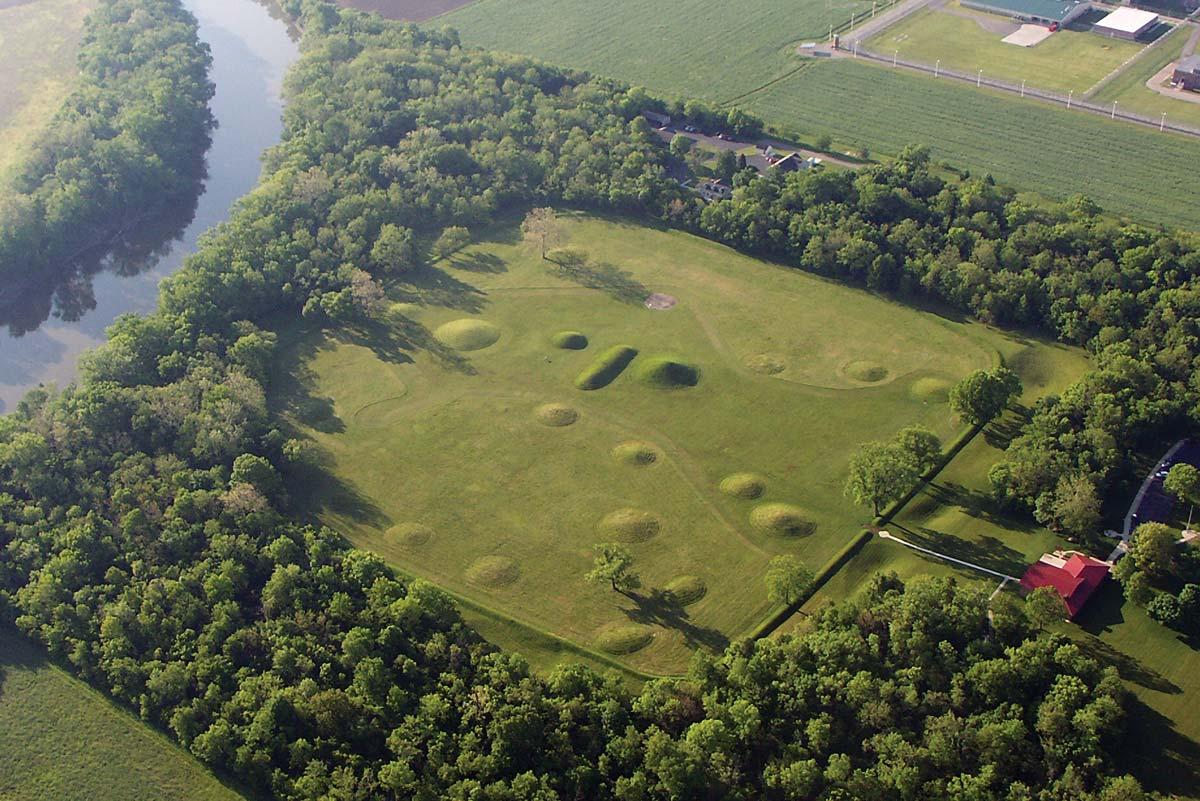
Mound City lies beside the Lower Scioto River in Ohio. Around A.D. 1, this valley began to be the epicenter of the expansion of Hopewell culture.
Photo by National Park Service
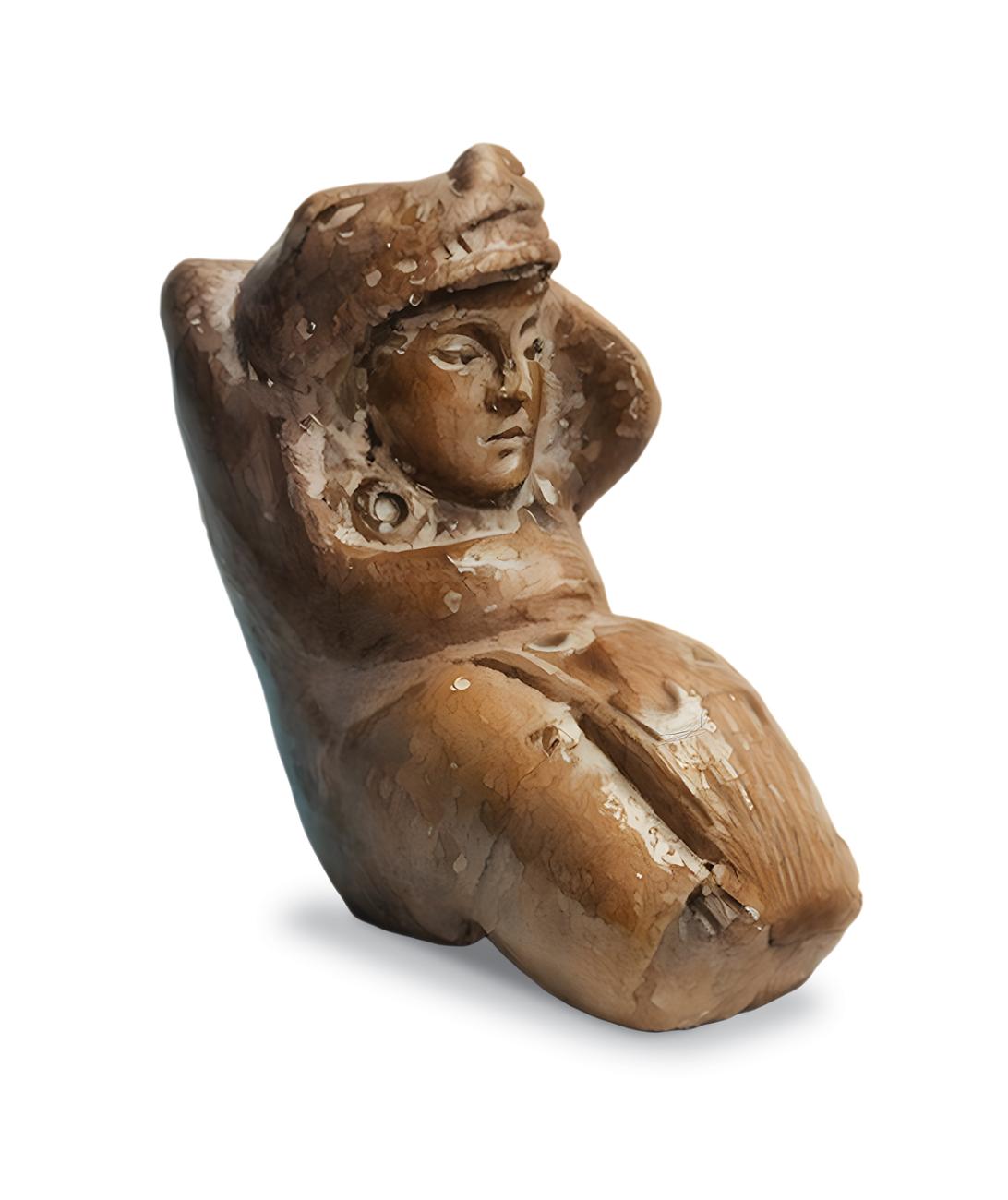
This painting by Shawnee artist Talon Silverhorn depicts a religious figure wearing a bear skin and earspools—the only artwork recovered from the mounds of the former Cherry Valley Ellipse earthwork.
Illustration by Talon Silverhorn

Tobacco has been essential for daily and ceremonial use in Indigenous cultures, including the Hopewell.
Illustration by Talon Silverhorn
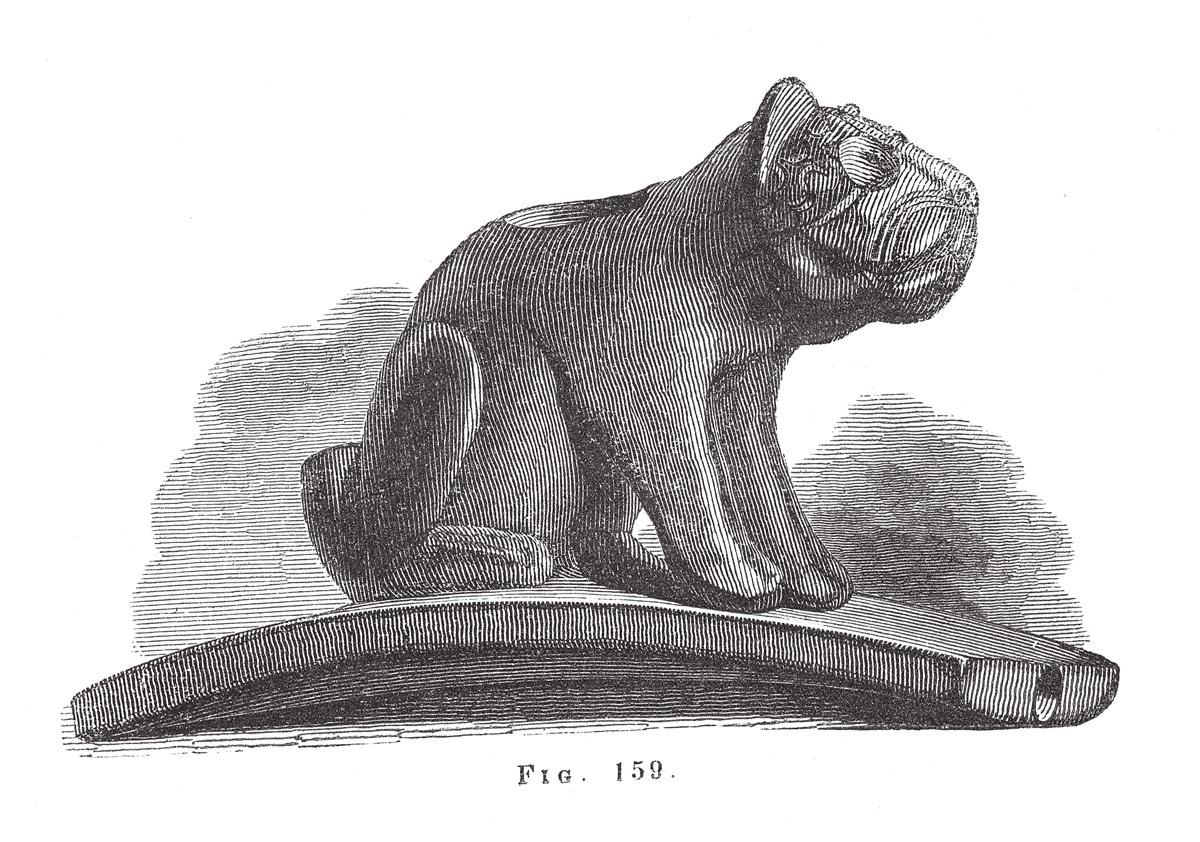
Effigy pipes such as this one with a mountain lion were among the many cultural items buried at Mound City.
Illustration by Squier and Davis, “Ancient Monuments”
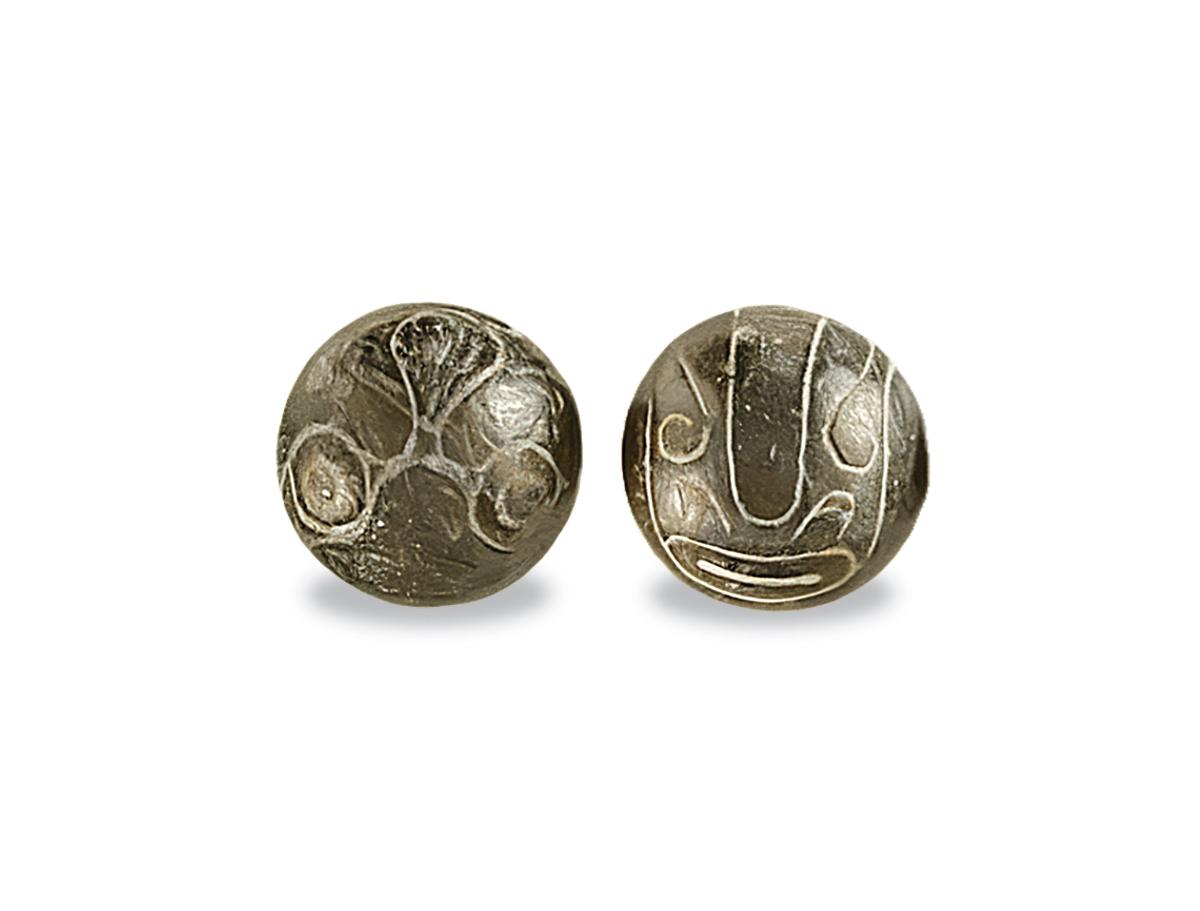
Two of five incised stones found under a mound at the Seip Earthworks were thought to be marbles, but a Native drum maker noted their resemblance to the drumskin fasteners that he still uses.
Illustration by Talon Silverhorn
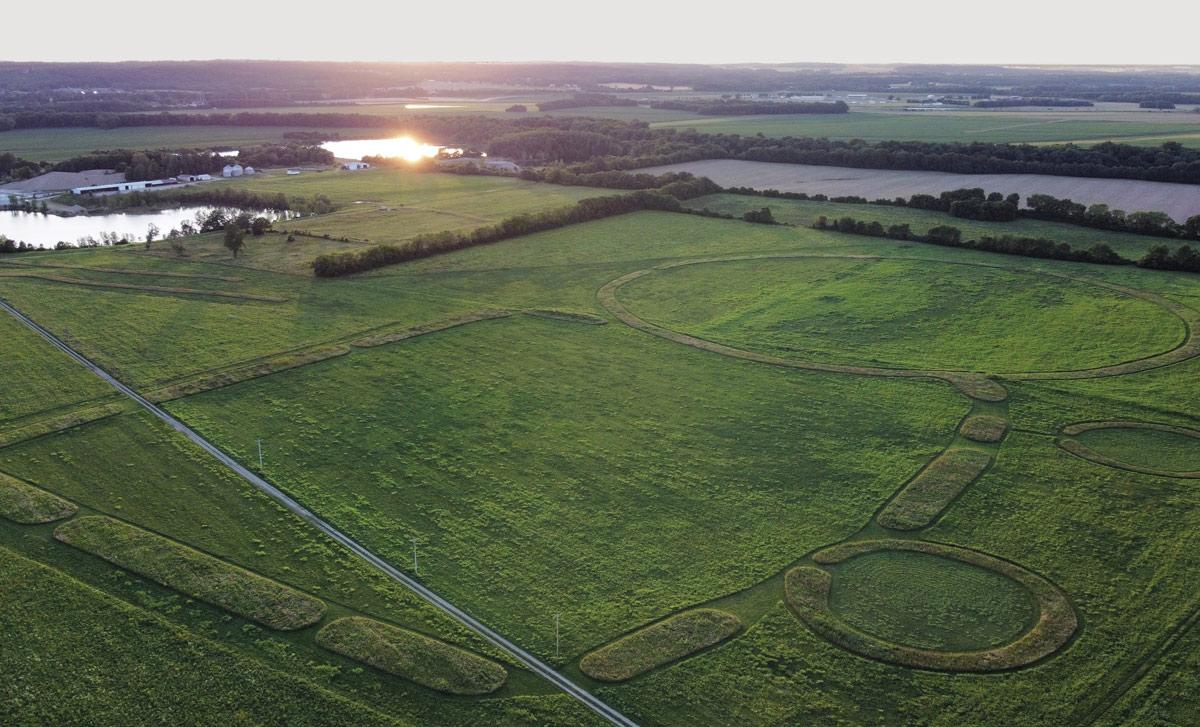
In 2016, Hopewell Culture National Historical Park began a planting and mowing method to bring the partially ruined walls at the Hopeton Earthworks into clear view.
Photo by Bret J. Ruby
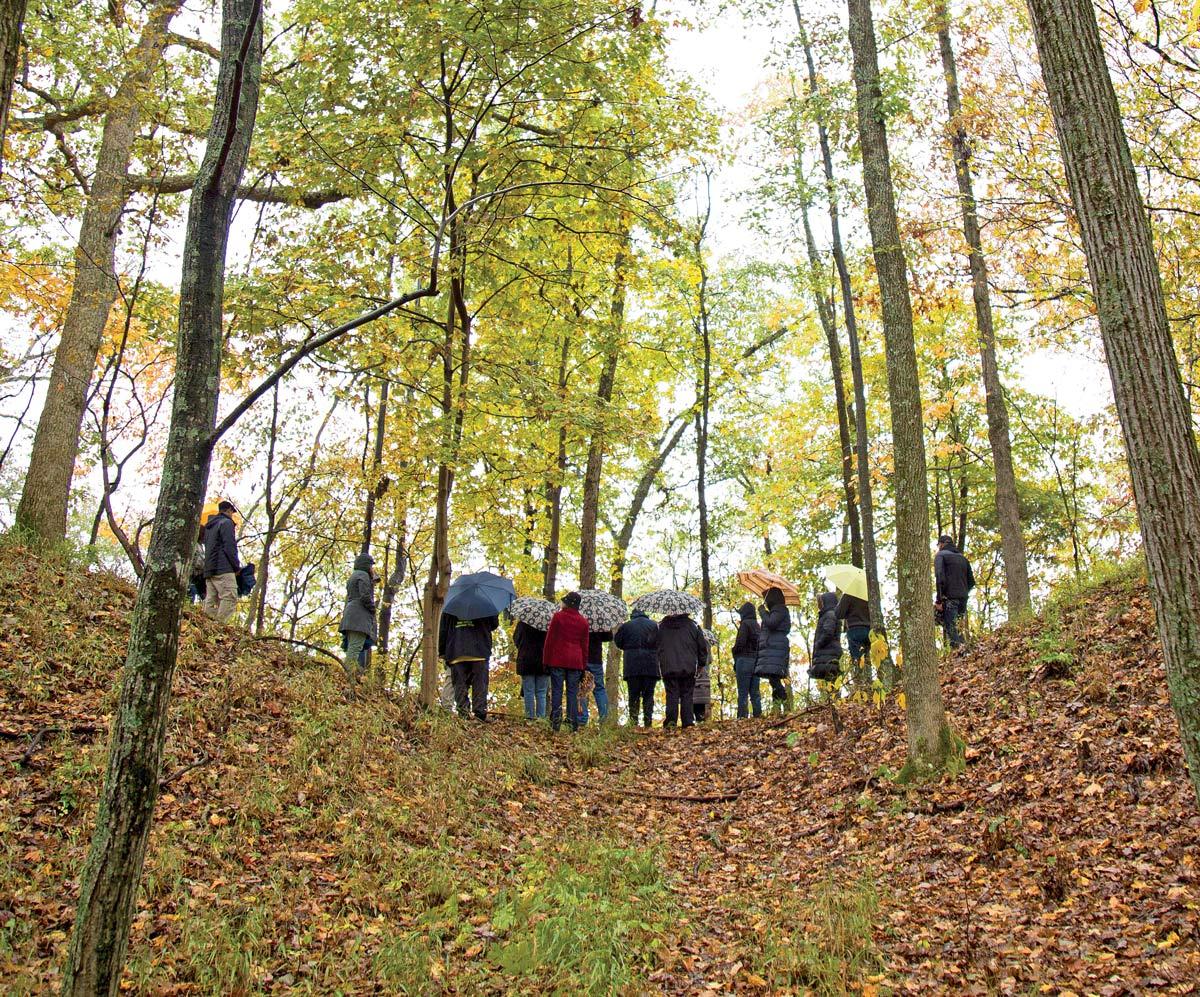
Representatives attending the Ohio History Connection’s 2017 Tribal Nations Conference gathered for a reflective moment at the Fort Ancient Earthworks.
Photo courtesy of Ohio History Connection
Those earth walls connect a large circle with an even larger, eight-sided enclosure. Two millennia ago, what’s now called the Octagon Earthworks were part of the largest geometric earthwork complex in the world. Other earthen lines and shapes were spread out across 4 square miles until the development of the present city erased most of them.
The moonrise we saw was the climax of an astronomical cycle that takes nearly 19 years to repeat. Moonrise positions swing from northeast to southeast along the horizon and back again every month, through an angle that expands slowly for 9.3 years and then contracts again at the same rate. Only while that angle is at its widest does the moon rise where we saw it that night, at its northernmost point. Marti Chaatsmith, a citizen of the Comanche Nation, said the ancestors who created this monument clearly “had a big vision—connecting their experience of sky and earth, geometry and the moon, within their measure of generational time.”
Long-Awaited Recognition
Just one year earlier, the United Nations Educational, Scientific and Cultural Organization (UNESCO) had designated the Hopewell Ceremonial Earthworks in Ohio as a World Heritage Site. Besides the Octagon Earthworks, this group includes one other geometric enclosure in Newark, five more about 60 miles to the southwest near the city of Chillicothe, and a hilltop enclosure in southwest Ohio called Fort Ancient. As World Heritage sites, they join more than 1,200 other remarkable natural and cultural sites worldwide that UNESCO considers to have “outstanding universal value.” These include such marvels as the pyramids in Egypt, Stonehenge in England, Machu Picchu in Peru and the great mounds of Cahokia—the remains of an ancient Indigenous city in Illinois.
Efforts to gain UNESCO recognition began in 2007. Although owned by the Ohio History Connection (an organization that manages the state’s historic sites), the Octagon Earthworks had been leased to a private country club for nearly a century. Eastern Shawnee Chief Glenna Wallace first visited the site that year. Her astonishment at the earthworks’ scope and precision turned to anger when a golfer shouted at her, “Out of the way! You don’t belong here!”
That incident inspired Chief Wallace to resolve to help remove golf from this sacred Indigenous site and to achieve World Heritage status for all the Hopewell Ceremonial Earthworks. Tribal leaders, the Ohio History Connection, the National Park Service (which manages the five Chillicothe sites) and a team of consultants went to work preparing a detailed nomination package demonstrating how the sites meet UNESCO’s strict criteria.
On September 19, 2023, in Riyadh, Saudi Arabia, the international delegates to the UNESCO World Heritage Committee unanimously voted to add the Hopewell Ceremonial Earthworks to its prestigious list. Chief Wallace spoke for all the tribal leaders who were there or who had helped with the nomination process by saying, “I am so humbled, so honored and so thankful that the world at long last recognizes the commitment, the spirituality, the knowledge of astronomy, mathematics, art, geology and aesthetic vision resulting in the imaginative thinking used by our ancestors to create these magnificent earthworks. They were not just geniuses. They were uncommon geniuses.”
Uncommon Genius
From about 800 B.C., Indigenous people throughout the greater Ohio Valley region thrived in these abundant lands. Known today as the Adena culture, they built thousands of burial mounds and many small earthen rings. Then about A.D. 1, new ideas suddenly emerged along what is now Ohio’s Lower Scioto River. Spiritual visionaries there initiated what archaeologist N’omi Greber has called an “explosion” of architecture, artistry and ceremony. Skilled artisans crafted elegant ceremonial objects and ritual regalia out of precious materials brought from far away such as Yellowstone obsidian, Smoky Mountain mica and Lake Superior copper. For the next four centuries, these new spiritual ideas and symbols (today known as part of the “Hopewell” culture) spread as far as Arkansas, Florida, Illinois and Ontario.
Their architecture made a huge leap in scale. Instead of just mounds, they designed huge, complex and precise earthwork enclosures. Rather than being part of cities or fortifications, they were ceremonial spaces. People gathered in them from great distances to form alliances, trade, socialize and hold ceremonies, which most likely included celebrations of the seasons and moon cycles, healing rituals as well as preparing their deceased kin for the world beyond.
Many ancient cultures aligned monuments to the sun as a guide for when to plant and harvest. But for reasons still unknown, these Indigenous architects created in what is now Ohio the only set of ancient monuments on Earth that capture the lunar cycle, both comprehensively and at multiple locations. That feat of genius required generations of observation and record keeping. Equally brilliant were their geometric layout skills, astonishingly exact even at vast scales. Several sites across the region used a common dimension of 1,054 feet, often achieved with only tiny margins of error. All this geometry and astronomy established the cosmic orders as the setting for their civic and ceremonial life. Building with Mother Earth, they marked their knowledge of the Sky World and of cyclical time—both the sun’s yearly repetitions and the moon’s generational ones.
“I think people [were] celebrating the whole human spectrum in these places,” Eastern Shawnee artist Talon Silverhorn reflected. “So not only are they looking at celestial bodies and understanding their movements and celebrating the cycles of the world around them but [also] more relatable human experiences—life, death, transformation.” This aligns with much in tribal life today. Tribes host large gatherings that include feasting, gift giving, dancing and games. As Chaatsmith has described, such ceremonies “emphasize the sacred and the connectedness of people with their beliefs, families, ancestors and communities—and with the natural world.”
Many of today’s tribes have traditions, practices and symbols that resonate with the cultural flowering of the Hopewell culture. During a visit to the earthworks, Donald Fixico (Shawnee/Sac and Fox/Muscogee Nation and Seminole) said, “All of us who are Indian are descendants of the mound builders. Their blood runs in our veins.”
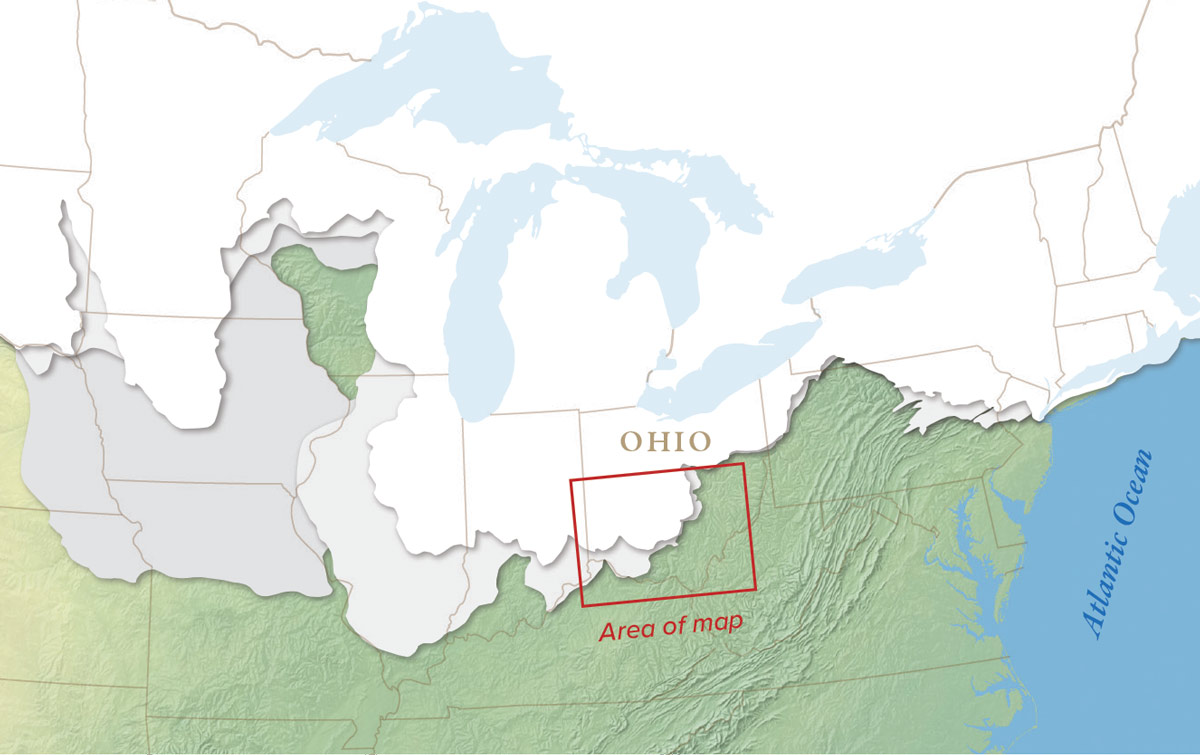
Top: Between 2.5 million and 12,000 years ago, ice sheets formed over what is now Ohio, creating a distinct boundary between flat and hilly terrain.
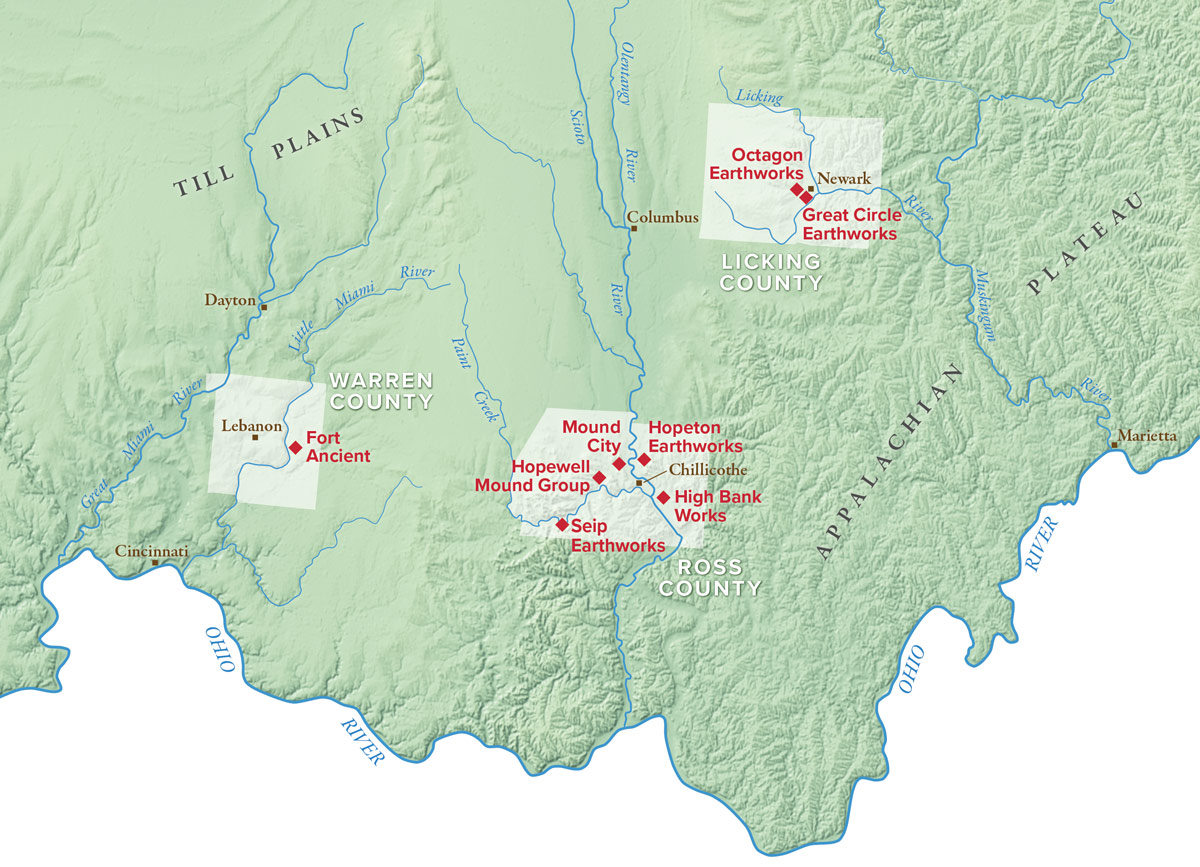
Bottom: The World Heritage earthworks are spread along the seam between the once-glaciated and unglaciated landscapes.
Cartography by Mike Boruta
The Earthworks
Today, the well-preserved Octagon Earthworks site in Newark is the best place to witness the moon’s rare alignments. But the other seven World Heritage earthworks in Ohio have more to tell us about their builders’ lives.
About 60 miles southwest from Newark, the Hopewell Mound Group fills a broad meadow near Chillicothe. This is very probably where the explosion of Hopewell cultural innovation was first ignited—or at least most fully elaborated.
Within a decade after the Indian Removal Act of 1830, all Native tribes were driven from Ohio and archaeological investigations at the earthworks began. At the Hopewell site (named for its non-Native landowner during the 1890s), excavations uncovered the largest quantity of ceremonial offerings, precious materials and elaborate graves ever found from the period. The number and variety indicated that the people were not led by powerful, hereditary rulers. Instead, leadership roles were earned and specific to different aspects of the community’s life.
Archaeological work continued at the Hopewell Mound Group into the early 1900s and also at the Seip Earthworks and Mound City sites nearby. Excavations uncovered whole tableaus of artistry, including shiny black obsidian blades up to 16 inches long and translucent mica sheets cut into human profiles and shining moonlike circles. Elaborate geometric and figurative copper shapes included some that were wrapped in linenlike fabric, preserved for centuries by the metal’s corrosion.
At Mound City, an earthen wall encloses two dozen mounds. Each one covers the remains of a timber-framed building where the dead were prepared—most by cremation—for their afterworld journey. Objects buried with them were broken and burned, suggesting that they were also respected as living beings whose spirit needed to be freed. Many of these pieces have become iconic symbols of the Hopewell culture, including a set of animal-effigy platform pipes.
Just across the Scioto River from Mound City, a 1,000-foot-diameter circle at the Hopeton Earthworks included the largest “woodhenge” structure known from this period. About a decade ago, a digital map generated by magnetic sensors (which can detect variations beneath the soil) revealed the evenly spaced traces of the giant, telephone-pole sized posts that had defined the circle’s perimeter.
A near-twin of the Octagon Earthworks lies a few miles downriver from Hopeton. The High Bank Works’ walls, corners and gateways also align to the key horizon positions of the long lunar cycle. Why all this effort to calibrate those complex moon movements? A clue may lie in much of Indigenous America’s use of lunar calendars. Also, some Native peoples say “Grandmother Moon” has special connections to the Beneath World and the souls of the dead. Delaware Grand Council Chief Linda Poolaw recounted that, “When our people go, our females, and that moon is full, they're dancing around the moon. And that's when we have our ceremony, and we talk to them, and we send them our prayers, so they can take them on to the Creator. Every time I see the full moon, I think about, you know, our ancestors, my mother and all of them, dancing around the moon.”
Thirty miles northeast of Cincinnati, the winding walls of Fort Ancient surround 100 acres on two connected hilltops overlooking the Little Miami River. (Like most other Hopewell hilltop enclosures, it was wrongly assumed to be a “fort” by non-Native colonial peoples.) A string of constructed ponds follows along the wall’s interior. Many of them still fill up during wet seasons and create the illusion that the earth walls are rising from or floating on the water. This effect evokes the three-level universe widespread in Indigenous cosmology: The Earth grows from the watery Beneath World, which also reflects the Sky World above.
Back in Newark, about a mile from the Octagon, the 1,200-foot-diameter Great Circle Earthwork rises to 14 feet high at its grand northeastern gateway. Its interior ditch was also engineered to hold water, suggesting a “Spirit Barrier.” As described by Robert Hall in his well-known book “An Archaeology of the Soul,” many Native traditions in the eastern United States have held that either water or circular geometry (or of course watery circles) can prevent the passage of unwanted supernatural influences.
Connecting Across the Centuries
A year after that chilly October evening in 2024, crowds returned to the Octagon Earthworks, eager to witness the moon’s repeat performance. By then the country club was gone, and the Ohio History Connection was making plans to rid the site of tee platforms and sand traps. Management of all these sites now includes collaboration with tribal leaders and scholars, as does research about the Hopewell culture and their earthworks. “Archaeology is beginning to understand,” said Silverhorn, “that there are pieces of that puzzle within our modern tribal communities that hold value.”
A research initiative at Hopewell Culture National Historical Park in Chillicothe reflects such co-stewardship. The “Hopewell Lifeways Project” focuses questions on the earthwork builders’ everyday life. This approach helps keep “the people in the forefront,” said Miami Tribal Historic Preservation Officer Logan York, who consults on the project. “Anthropology learns from afar, but there’s people, there’s families, there’s kids—memories and lives that were happening.”
One example of the benefit of such collaborative research is when Shawnee Chief Ben Barnes worked with Ohio History Connection archaeologist Brad Lepper to reinterpret five stone spheres from Seip Earthworks, once assumed to be marbles. Barnes is a traditional drum maker, so he recognized them as likely part of a drumskin’s fastening system.
Perhaps most importantly, following recent consultations with tribal members, nearly all those crafted objects from the mounds have been removed from public view. This respects tribal beliefs that they may have an unknown animate power and that the ancestors buried them for a reason. Photographs of them are also avoided now, but new facsimiles and original artworks such as those Silverhorn creates can still convey their makers’ brilliant artistry.
With World Heritage designation, the Hopewell Ceremonial Earthworks now stand as the defining monuments of a brilliant civilization. But for their Indigenous descendants, they are also sacred places preserving ancestral knowledge. “These sites will always be important cultural patrimony for American Indians and a legacy left to us by our ancestors,” said former Newark Earthworks Center Director John Low (Pokagon Band of Potawatomi). But they also offer, he continued, “the opportunity to come together for healing among ourselves and with non-Native peoples, too.”
Standing in the dark at the Octagon Earthworks in October 2025 was an opportunity for all of us to bear witness again to the uncommon genius of America’s Indigenous peoples. Voices once again fell silent as the moon slowly rose into view, just where those perfect earthen walls told us it would—and where it will be seen again in another 18 years.