
Although Native peoples represent only 5 percent of Canada’s population, the majority of the residents in the country’s remote communities are Indigenous. Often the only way for them to get vital supplies or reach critical care facilities is by plane or helicopter.
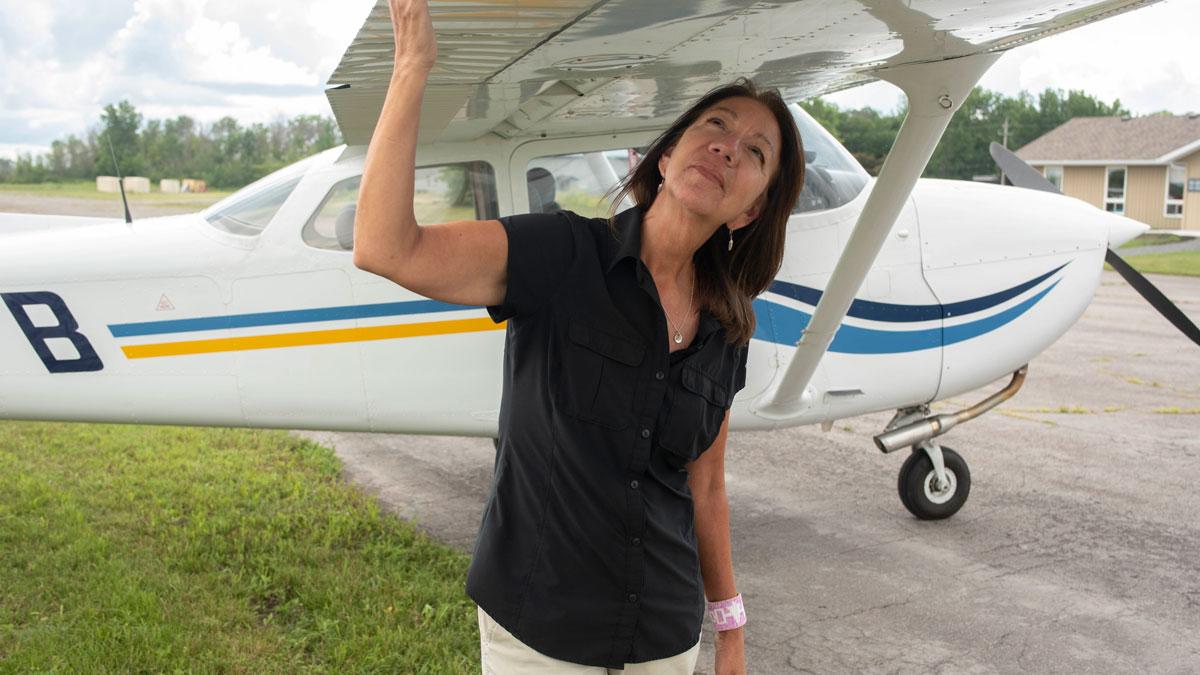
Jo-Anne Tabobandung touches a Cessna 172 on the grounds of the First Nations Technical Institute in Ontario, Canada. Now dean of its aviation school, she was among its first students, graduating in 1990.
Photo by Shelby Lisk
“For the smallest demographic of people, we rely the most heavily on air transportation,” said Jo-Anne Tabobandung, a Mohawk pilot who is now dean of aviation at the First Nations Technical Institute (FNTI), the only post-secondary Indigenous aviation program in the country. “A lot of our graduates are back in their communities doing medevac flights, transporting seasonal workers and cargo—all of the essential services that the communities need.”
FNTI was founded to offer technology programs that support First Nations. Earl Hill, the former chief of the Mohawks of the Bay of Quinte, started the FNTI aviation program in 1989 at the Belleville airport in southeast Ontario. In 1990, it relocated 22 miles northeast to the Tyendinaga Mohawk Territory, Tabobandung’s home community. Since then, more than 200 First Nations, Métis and Inuit students from communities across Canada have graduated from the program, including Tanisha Natomagan.
From the Métis and Cree community of Pinehouse, Saskatchewan, Natomagan started as a medevac pilot for Missinippi Airways in 2024, flying a small utility plane to take passengers from the Cree community of Pukatawagan in northern Manitoba to urban areas. Pukatawagan is accessible by plane, a train from the town of The Pas or an ice road that forms only during winter. As she also came from a community with limited resources, she said “being able to be that person to help them, especially when a lot of it is critical,” is meaningful to her.
Starting this fall, the institute will offer helicopter pilot training. Such aircraft can land in compact areas and challenging landscapes. They can also carry high-strength rope systems able to lift heavy objects such as construction materials, fire-fighting equipment and people during emergency rescue missions.
The aviation program is just one of the educational opportunities at FNTI. The institute also offers degrees or certification programs in Indigenous justice, social work, early childhood education, journalism and other disciplines. The school’s students are “role models,” said Tabobandung. “When one of our students graduates, it affects them, their family, their extended family, their community and their nation.”