
Some Tlingit peoples tell the story of a young woman who would frequently go to Yaaw Teiyi (Herring Rock) in Sitka Sound off the southeast coast of Alaska. There, she would sing to the “yaaw” (Pacific herring), inviting them to visit with her. One day she fell asleep by the water, and as the tide rose, her long hair spread out on the surface. The herring swam to it and laid their eggs in its strands. When she returned to her village, her hair was thick with this herring roe. Her people realized they could collect the fish’s sticky roe during the spring spawning runs either from the blades of the nearshore kelp forests or from hemlock tree branches anchored in the water.
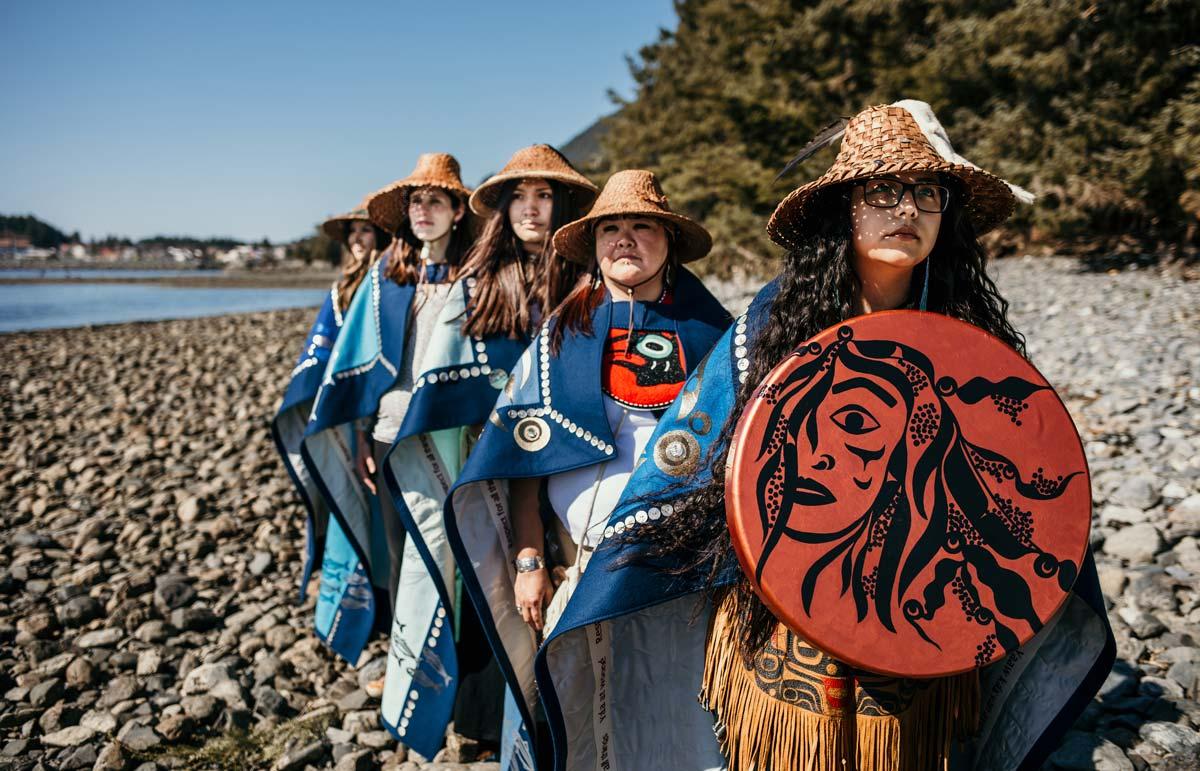
The Herring Protectors are fighting to keep traditional uses of herring alive in Alaska.
Photo by Caitlin Blaisdell/Herring Protectors
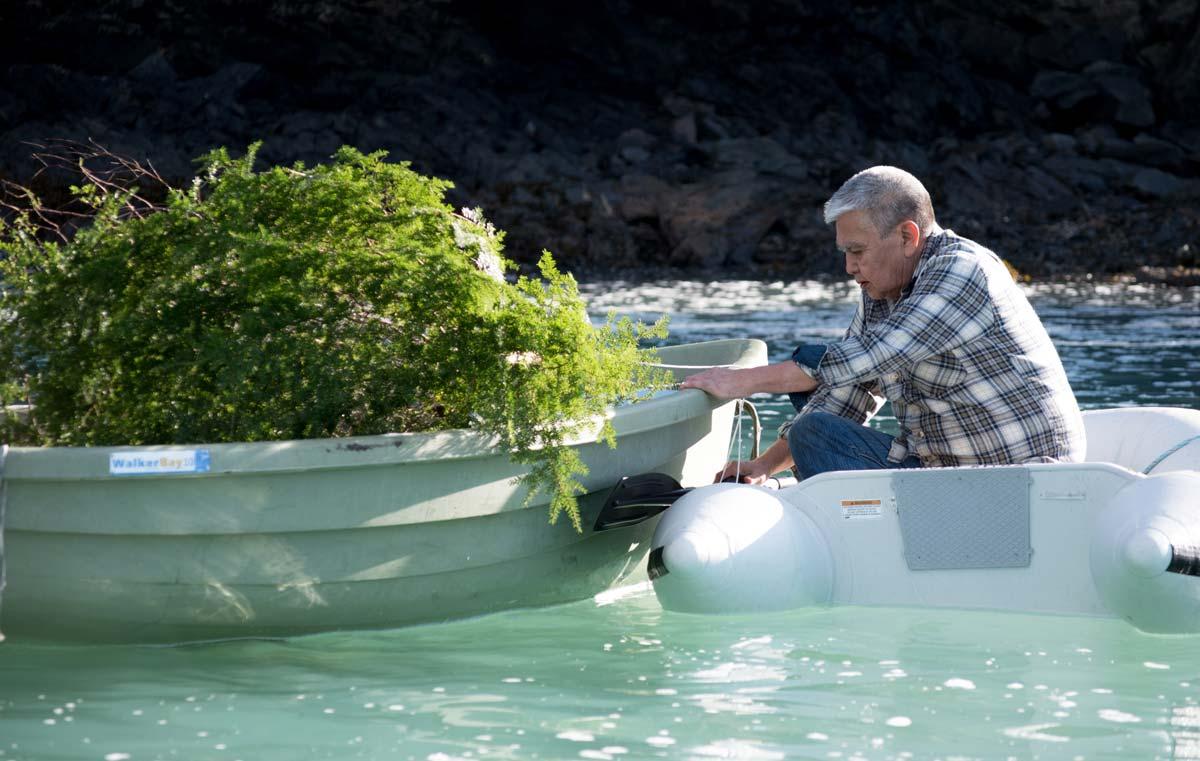
Harvey Kitka prepares to lay branches into Sitka Sound, Alaska.
Photo by Bethany Goodrich/Herring Protectors
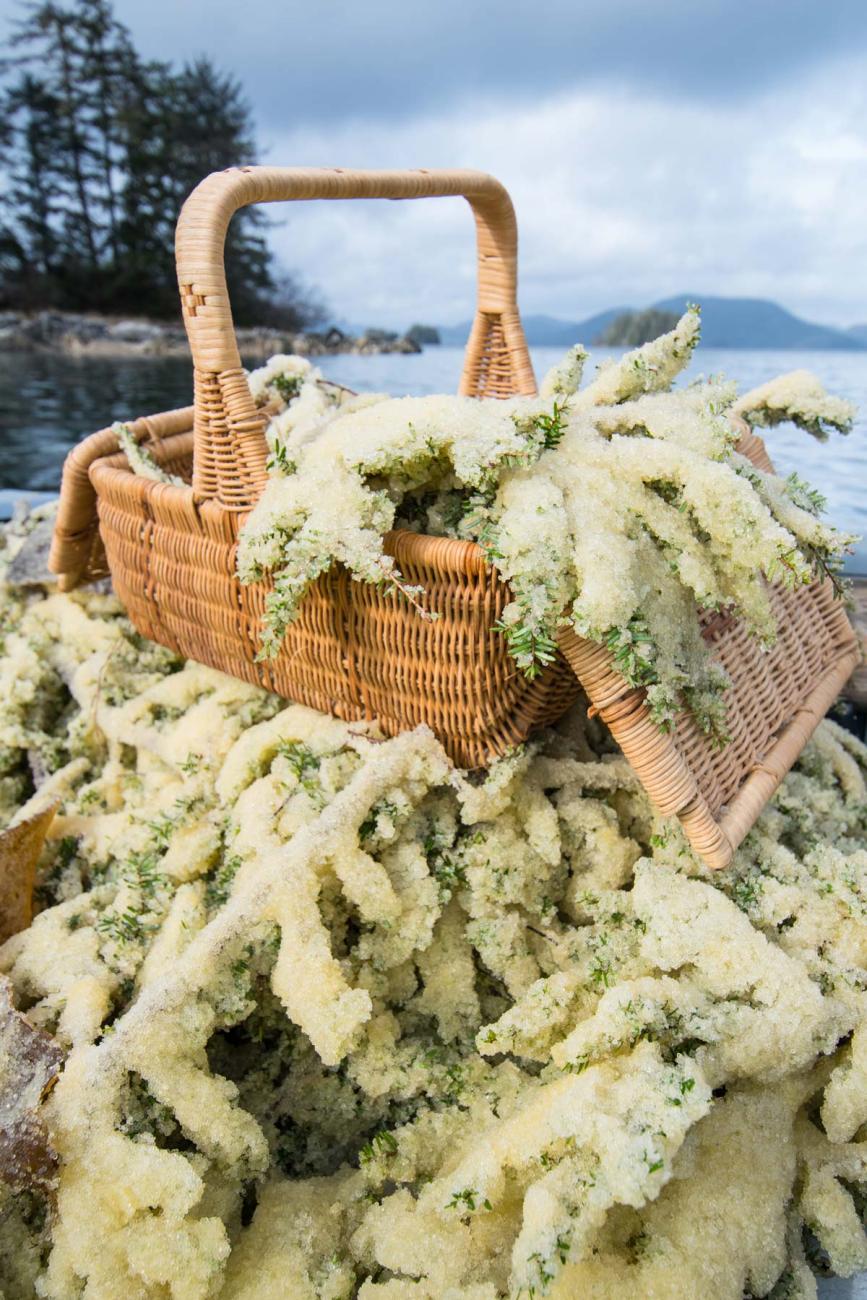
When harvested days later, they will be covered in herring eggs, or roe—a precious gift that is often given to family and other community members.
Photo by Bethany Goodrich/Herring Protectors
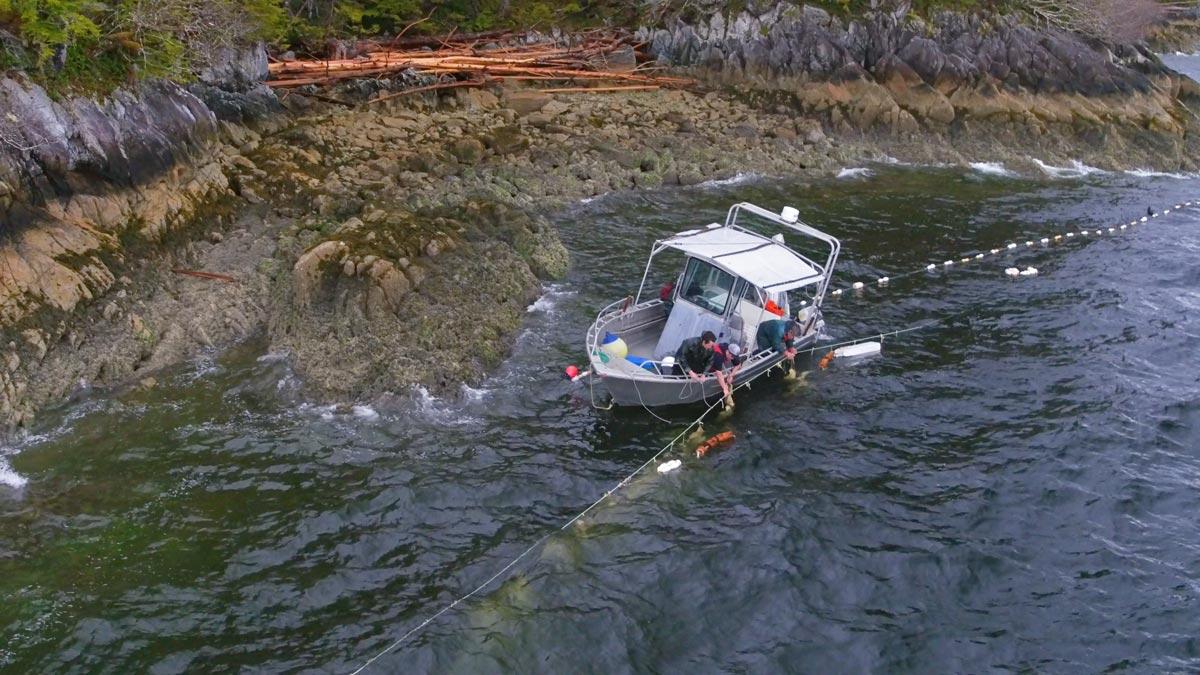
Saul Brown (front, Heiltsuk Nation) and his family harvest herring roe from kelp hanging from a line into waters near Bella Bella, British Columbia.
Photo by Damien Gillis and Charity Gladstone/Heiltsuk Nation
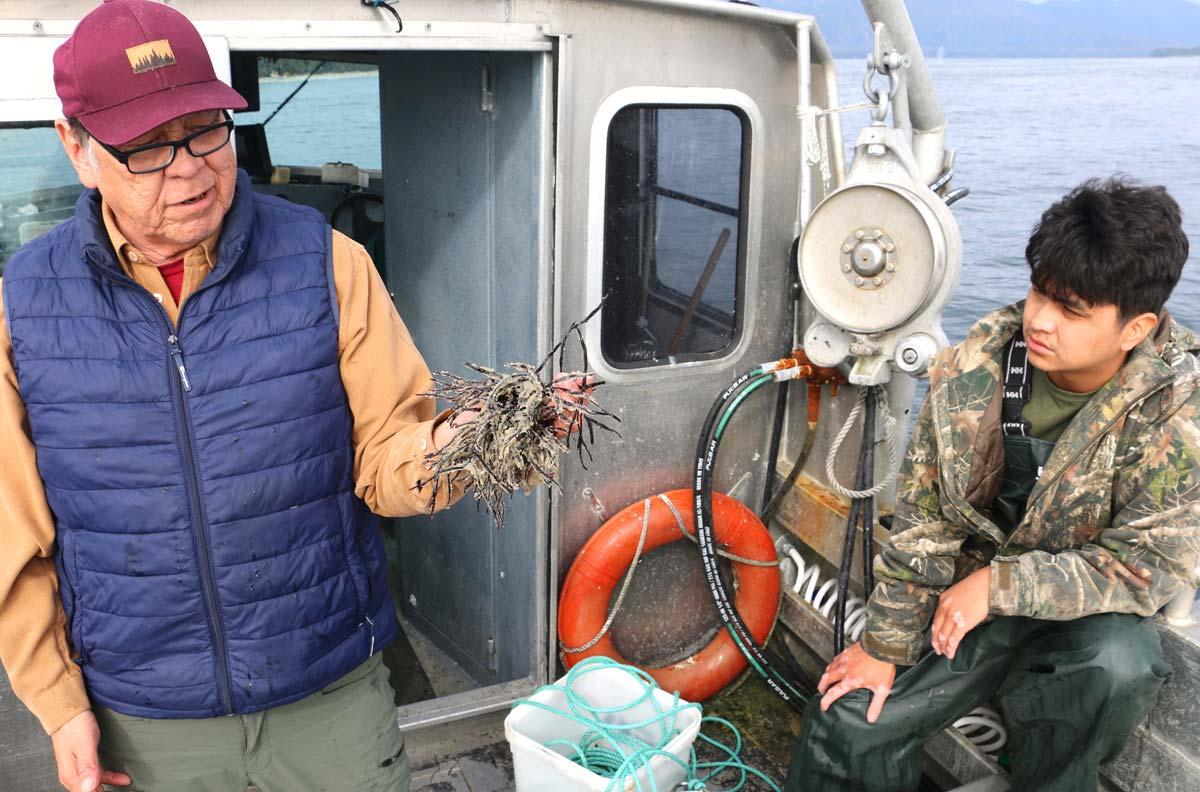
As part of their evaluation of the regional herring population for the Nuu-Chah-Nulth Nations, Rufus and Jaydin Charleson (Hesquiaht First Nation) count rows of herring eggs laid on branches off the coast of British Columbia.
Photo by Irine Polyzogopoulos/Uu-a-thluk
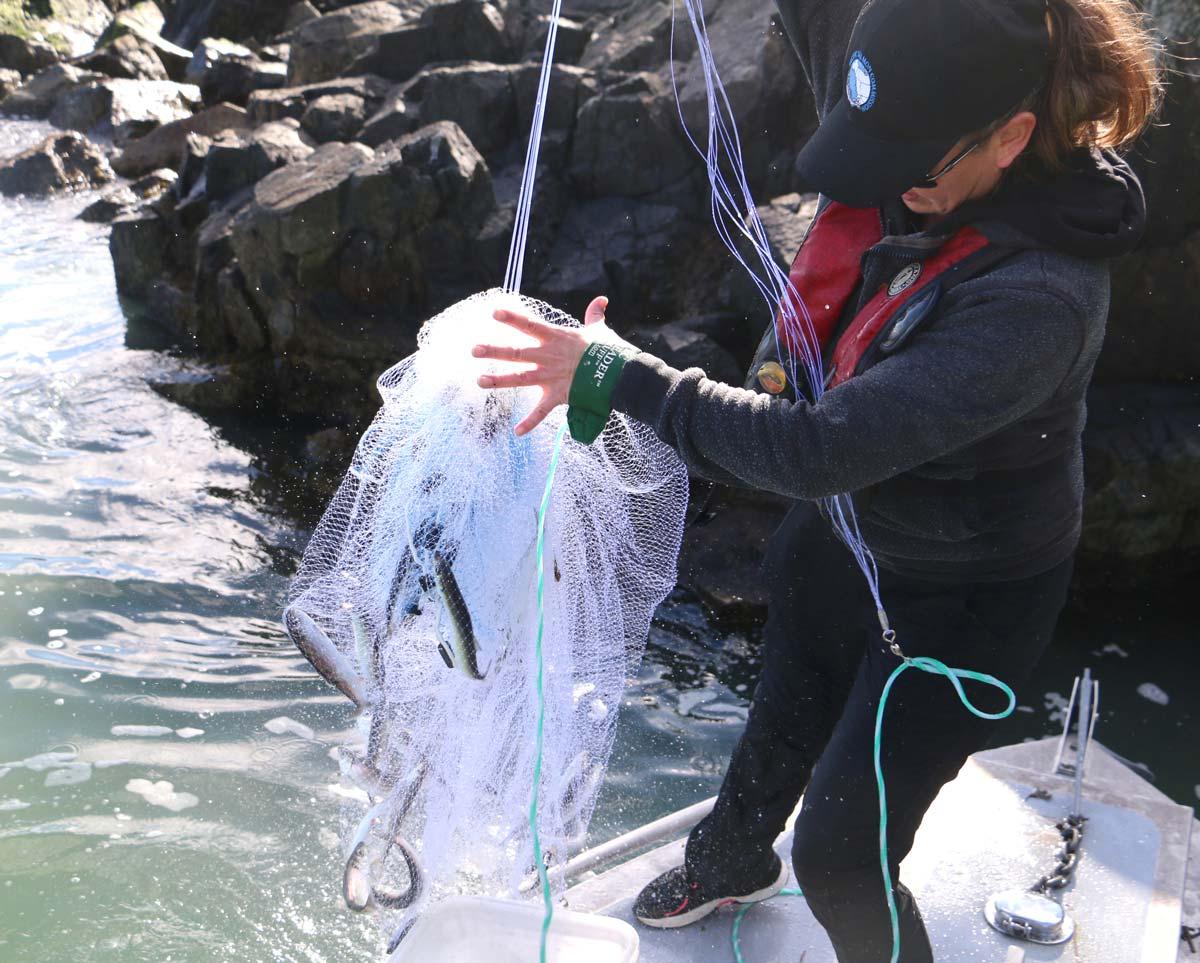
Biologist Sabrina Crowley (Uchucklesaht Tribe) pulls out a net containing herring that will be counted and measured.
Photo by Irine Polyzogopoulos/Uu-a-thluk
For thousands of years, Indigenous peoples have harvested herring eggs, or roe, from the kelp that grows in the ocean along the Pacific Coast, extending from the Russian far east to California. Although declining populations of herring have vastly limited this harvest, it remains a cherished source of food, celebration and sovereignty for many Indigenous peoples in Alaska and British Columbia, some of whom acknowledge herring as their relatives.
“They are a part of our DNA,” said Louise Brady (Tlingit). “It hasn’t to do with money. It’s a cultural, spiritual, historical and social connection for us.” She helped found the Herring Protectors, a nonprofit organization based in Sitka, Alaska, that has helped bring back herring ceremonies, music and regalia to the Tlingit peoples, including brightly colored Herring Woman robes.
Having grown up in Sitka “my father and brother both harvested, and we always sent eggs on branches to relatives and friends in Seattle and Barrow [now Utqiagvik, Alaska],” Brady recalled. “The herring still come in the spring. How joyful this time of year is. There’s nothing like it when we have the herring Koo.e’ex’ [ceremony] right after the harvest.” (At their Koo.e’ex’ last year, Brady’s son wore a traditional Sculpin Hat that a Smithsonian team from Smithsonian Exhibits, the National Museum of Natural History and the Digitization Program Office recreated from a broken ancient hat using 3D technology.)
Eggs on kelp or on branches is a traditional gift to family and friends and is also traded for other necessary staples, such as moose, seal and goose meat or fish oil. However, warming seas, pollution and commercial overfishing has limited the herring roe harvest. The availability of the fishes’ roe dropped dramatically when “reduction fisheries” of the 20th century removed more than a million tons of herring from southeast Alaska waters for fish meal, fertilizer and oil. Then, during the 1960s, demand for herring roe skyrocketed as it started being shipped to Japan as komochi konbu, a high-end delicacy—salty, creamy, and crunchy like Pop Rocks candy—that sold for as much as $40 a pound.
While some of the Tlingit peoples of southeast Alaska and Heiltsuk First Nation of British Columbia are able to harvest in significant quantities to give roe to family and friends and sell to others outside their communities, other Indigenous nations in Canada conduct more limited harvests, including the Haida, the Kitasoo Xia’xais, Nuxalk, Wuikinuxv, Tsimshian, Nuu-Chah-Nulth and Hul’q’umi’num peoples.
Since the Herring Protectors’ founding in 2018, the group has been fighting Alaska state permits that still allow a sac-roe fishery in which the fish are killed, stripped for their roe and their remains turned into fish meal for salmon farms. This takes approximately 20,000 tons of fish a year from Sitka Sound. Brady and others worry that this kind of commercial fishery is further reducing the already depleted herring. Because on average herring spawn as many as five to seven times in their lifetimes, collection of their sticky eggs on kelp or evergreen boughs is a harvest technique that is considered more sustainable and respectful of Indigenous sovereignty. “It’s the last traditional food you can harvest without a permit and without killing one herring,” Brady said. In the spring, the shoreline still becomes milky white and turquoise with miles-long slicks of milt (spawn), but nothing like at the scale many elders recall.
Harvey Kitka (Tlingit) is the former chair of the Tlingit’s Herring Committee. Now 84 years old, he said, “When I started fishing with my father back in about 1950, the herring spawn covered the whole of Sitka Sound. … Our history says when America bought the town sites of Sitka, there’d be almost 10,000 Indians come to harvest herring roe. They’d [the fish] come here to spawn for about 30 days. Right now, we’re getting about five days of spawn. Still, we’re able to get enough for ourselves and extended families. Not everyone goes out, so there’s aunts, uncles, cousins to take care of. I kind of trained my nephews to harvest for other people. So, as long as I’m alive, my nephews and children will harvest and I’ll have something. We’re teaching younger people how to go about it. We take only what we need.”
The desire for roe remains strong in Indigenous communities of Alaska and the Pacific Coast. Among the many ways herring eggs are eaten are fresh, sprinkled with soy sauce, lightly simmered in water or fried in seal oil, Oolichan grease (candlefish oil) or butter—though the number of preferences seem to be as many as the number of fish eggs.
For Saul Brown, an elected council member from the Heiltsuk Nation in Bella Bella, British Columbia, “I like it fried, with garlic butter or on stringy kelp, with hot water poured over it and a simple soy sauce dip,” he said. “But really fresh, out of the water and right into your gullet, is my favorite [way]—with the taste of the evergreen and saltiness of the ocean and a unique pop. It’s almost poetic.”
Brown has been harvesting with his family since he was young. He recalled, “In spring, it’s still cold, wet and rainy. You get out to where the harvest is and it’s snowing and you’re out on a skiff [small boat], and so for us, it’s usually for able-bodied folks.” His father, cousins or sister would put out a line in the water to hold his family’s spot and anchor or float tree branches to provide a surface on which the herring can lay their eggs or they would collect the eggs laid on wild kelp. They return several days later to watch for otters, seals and seabirds—one indicator of when the spawn is happening. He continues the tradition with his own family. “I have a young daughter, and for us the herring come when the moon tips over, goes past the new moon [or “Qumsista” in the Heiltsuk language]. It’s our New Year, the celestial gift,” he said.
To maintain that gift, the Heiltsuk Nation has decided not to run a commercial fishery for export for the last several years, even though that means a 3-million-dollar to 6-million-dollar loss to the small community of about 1,200 people. It also initiated a project aimed at restoring some traditional spawning grounds that are no longer active.
“One of our stories is that our Raven trickster managed to secure some herring and brought them from one area to another in a canoe. [Raven] chanted and they came back to life and tipped the canoe over,” Brown said. “So, we’re testing Raven’s theory of transporting food sources. We’re moving 183 hemlock trees with herring spawn on them to historic spawning sites to see if they’ll come back.”
Along the western shore of Vancouver Island off Canada’s Pacific Coast, the long-term decline of herring in the Nuu-Chah-Nulth territories was so severe that the Nuu-Chah-Nulth Nations successfully pushed for the area’s commercial herring fishery to be closed in 2006. The First Nations then won a court injunction against the government of Canada’s attempt to reopen it in 2014. During the past several years, some communities along the shore have seen dramatic increases in numbers of usmit, or Pacific herring, for the first time in decades.
Judith Sayers, president of the Nuu-Chah-Nulth Tribal Council that represents the 14 Nuu-Chah-Nulth First Nations, said her people are still not harvesting in great amounts. “Though the herring has [now] come back, there’s still concern that some of the spawning areas are not being used [by the fish]. So, while some First Nations are now authorizing spawn on kelp and branch [harvesting], we’re being cautious,” she said. “I think in the last couple of years, more communities are harvesting. The 14 nations get together and talk about it but it’s up to each chief to decide: ‘Are the herring back for good?,’ or ‘Is this just a few good years?’ We want to make sure there will always be herring.”
To monitor the fish’s population, the Nuu-Chah-Nulth Nations’ fisheries program combines Indigenous and western science. The Nuu-Chah-Nulth Tribal Council’s Aquatic Resource Management Department monitors herring, groundfish, salmon and shellfish populations off the west coast of Vancouver Island. Crews cast small nets to collect a few herring as the fish spawn to send them off to a lab to be analyzed, which includes determining their age and size as well as other factors that can help evaluate the health of the fish’s population. While Canada’s Fisheries and Oceans institute contracts divers to conduct underwater surveys, the First Nations use metal rakes on chains to gather marine vegetation on which fish have laid their eggs. The amount of eggs can also reveal whether that fish population is thriving.
The scientists also survey the growing populations of marine mammals in the area, including whales and seals that feed on herring. The impacts of these predators are considered “like another [fishing] fleet,” when putting together models for regional fishing plans, said Aquatic Resource Management Department director Jim Lane. “In the right conditions [the herring] can go like gangbusters or collapse the other way, which is why it’s so important to have collaborative relationships [between the nations, fisheries researchers and the government].”
“Now we have enough expertise and capacity in our communities to monitor the stock and determine when to allow harvest and when to close it down,” Sayers said. “Our management skills will allow us to make sure numbers of herring come back, So, we’re feeling a bit better.”
Elder Harvey Kitka said he looks forward to the roe every year that whales, bears, seals and seabirds also depend upon. It is “one of the first foods we have after winter. Herring come March into April for a while. That’s our first sign of spring. And then they’re gone, and salmon and halibut come after that. The herring spawn, the plankton blooms, the ocean warms up, then the whales—they might be coming in after the herring and taking eggs that wouldn’t otherwise hatch out. There are so many branches to [the marine ecosystem],” he said. “We get our science from thousands of years of watching, of observing. A lot of us have taken care of these systems for an awful lot of time.”